
Knowing which poker hand beats another is basic to playing the game well. Without this knowledge, you can’t make smart choices at the table or know when you have a winning hand. In poker, hands are ranked in a set order from strongest to weakest, with a royal flush being the best possible hand and a high card being the lowest.
Every poker hand fits into one of several categories. These categories follow a clear ranking system that stays the same across most poker games. The rank of a hand depends on the pattern its five cards make and how rare that pattern is to get.
This guide will walk you through each poker hand from top to bottom. You’ll learn what beats what, how to rank hands within the same category, and what rules can change based on the poker game you’re playing. Whether you’re just starting out or need a quick review, understanding hand rankings is the first step to playing poker with confidence.
Understanding Poker Hand Rankings
Every poker game uses the same standard hand rankings to determine winners. Learning these rankings lets you know when you have a strong hand and when you should fold.
Hierarchy of Poker Hands
Poker hands ranked from strongest to weakest follow a clear order. Royal Flush sits at the top as the best poker hand. It’s an A-K-Q-J-10 all in the same suit.
A Straight Flush comes next with five cards in order and matching suits. Four of a Kind means you have four cards of the same rank. A Full House combines three cards of one rank with two cards of another rank.
Flush ranks in the middle with any five cards of the same suit. A Straight has five cards in order but different suits. Three of a Kind gives you three matching cards.
Two Pair means you hold two different pairs of matching cards. One Pair is just two cards of the same rank. High Card is the lowest ranking when you have no matching cards at all.
What Beats What in Poker
You need to know what beats what to win at poker. Any hand beats all hands below it in the rankings. A Flush always beats a Straight. A Full House beats a Flush every time.
When two players have the same type of hand, the higher cards win. A pair of aces beats a pair of kings. If both players have the same pair, the highest side card (called a kicker) breaks the tie.
Suits don’t matter for ranking hands. A heart flush has the same value as a spade flush. Only the card values determine the winner.
Official Poker Hand Rankings Chart
| Rank | Hand Name | Example | Probability |
|---|---|---|---|
| 1 | Royal Flush | A♠ K♠ Q♠ J♠ 10♠ | 0.0032% |
| 2 | Straight Flush | 9♥ 8♥ 7♥ 6♥ 5♥ | 0.027% |
| 3 | Four of a Kind | 7♣ 7♦ 7♠ 7♥ K♠ | 0.17% |
| 4 | Full House | Q♦ Q♠ Q♥ 4♣ 4♦ | 2.6% |
| 5 | Flush | K♠ 10♠ 7♠ 5♠ 2♠ | 3.0% |
| 6 | Straight | 10♥ 9♣ 8♦ 7♠ 6♥ | 4.6% |
| 7 | Three of a Kind | 8♣ 8♦ 8♥ A♠ 5♣ | 4.8% |
| 8 | Two Pair | J♠ J♦ 3♥ 3♣ K♠ | 23.5% |
| 9 | One Pair | 10♦ 10♣ A♥ 7♠ 4♦ | 43.8% |
| 10 | High Card | A♣ K♦ 9♥ 6♠ 3♣ | 17.4% |
This poker hand rankings chart shows you exactly where each hand ranks. The probabilities tell you how rare each hand is by the river in Texas Hold’em.
The Poker Hands Ranked From Best to Worst
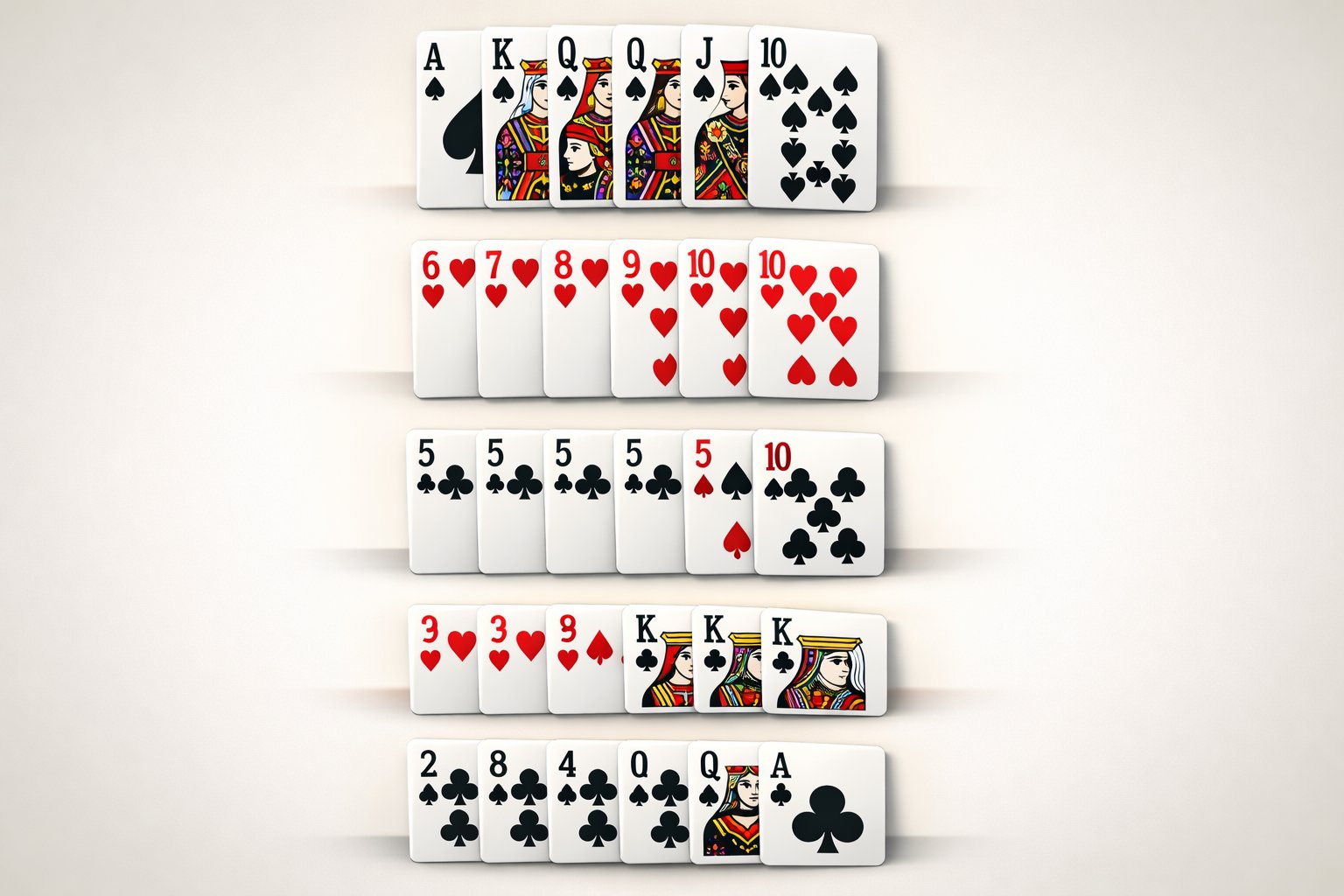
The best hand in poker is a royal flush, which consists of an ace, king, queen, jack, and ten of the same suit. A straight flush follows as the second-best hand, while four of a kind (also called quads) ranks third, and a full house takes the fourth position.
Royal Flush Explained
A royal flush is the best poker hand you can possibly get. It contains five specific cards: an ace, king, queen, jack, and ten, all in the same suit. You can make a royal straight flush in any suit—hearts, diamonds, clubs, or spades.
This hand cannot be beaten by any other poker hand. Only four royal flushes exist in a standard 52-card deck, making it extremely rare. Most poker players only see a handful of royal flushes in their entire lifetime.
The odds of being dealt a royal flush are about 1 in 649,740 in Texas Hold’em. When you have this hand, you have a guaranteed win at showdown. The suit doesn’t matter for ranking purposes since all suits are equal in poker.
Straight Flush Overview
A straight flush is the second-best poker hand. It consists of five consecutive cards of the same suit, like 5-6-7-8-9 of hearts. The cards must be in sequential order and all match in suit.
The highest straight flush is jack-queen-king-ace-ten (which is the royal flush). The lowest straight flush is ace-2-3-4-5, also called a wheel or bicycle. When two players have a straight flush, the one with the higher top card wins.
There are 36 possible straight flush combinations in a standard deck. This makes them much more common than royal flushes but still very rare. Only a royal flush or a higher straight flush can beat this hand.
Four of a Kind and Quads
Four of a kind, commonly called quads, is the third-best poker hand. You have four cards of the same rank, like four aces or four sevens. The fifth card in your hand is called the kicker.
When two players both have quads, the player with the higher set of four wins. For example, four kings beat four jacks. If both players somehow have the same four of a kind (possible in community card games), the player with the higher kicker wins.
There are 624 possible four of a kind combinations. This hand beats all other hands except royal flushes and straight flushes. You’ll see quads more often than straight flushes, but they’re still uncommon enough to win most pots.
Full House Details
A full house combines three cards of one rank with two cards of another rank. You might have three queens and two fives, or three eights and two aces. Both combinations count as a full house.
When comparing full houses, the three-of-a-kind determines the winner first. Three aces with two kings beats three kings with two aces. If two players have the same three-of-a-kind (in community card games), the pair breaks the tie.
A full house ranks fourth in poker hand strength. It beats flushes, straights, three of a kind, two pair, one pair, and high card hands. Only royal flushes, straight flushes, and four of a kind can beat it. There are 3,744 possible full house combinations in a standard deck.
The Remaining Poker Hands and Their Strength
Between the powerful full house and the weak high card lie several poker hands that you’ll encounter frequently at the table. These mid-range hands include flush, straight, three of a kind, two pair, and one pair, each with distinct characteristics that determine when they’re strong enough to play aggressively or when caution is needed.
Flush Hands
A flush contains five cards of the same suit that don’t form a sequence. All five cards must be hearts, diamonds, clubs, or spades to qualify as a flush.
When you hold a flush, you beat any straight, three of a kind, two pair, one pair, or high card. The strength of your flush depends on the highest card in your hand. An ace-high flush beats a king-high flush, which beats a queen-high flush, and so on.
If two players both have a flush, you compare the highest card first. If those match, you move to the second-highest card, then the third, fourth, and fifth if needed. Your kicker cards matter significantly in flush versus flush situations.
Flushes rank sixth in the poker hand hierarchy. They’re stronger than straights because they’re less common to make.
Straight Hand
A straight consists of five consecutive cards of mixed suits. The ace can work as the highest card (in an ace-king-queen-jack-ten straight) or the lowest card (in a five-four-three-two-ace straight, also called a wheel).
You cannot wrap around with a straight. A king-queen-jack-ten-nine beats a queen-jack-ten-nine-eight, and any ace-high straight (called Broadway) is the strongest possible straight.
When two players have straights, the one with the highest top card wins. A nine-high straight beats an eight-high straight. If both players have identical straights using all community cards, the pot splits between them.
Straights rank seventh overall, below flushes but above three of a kind. They occur more frequently than flushes, which explains their lower ranking in the hand strength hierarchy.
Three of a Kind: Sets and Trips
Three of a kind means you have three cards of the same rank. The poker community uses two specific terms to describe how you make this hand.
A set happens when you hold a pocket pair in your hand and match it with one card on the board. For example, if you have two eights in your hand and an eight appears in the community cards, you flopped a set.
Trips occur when two of the three matching cards are on the board and you hold one in your hand. If the board shows two queens and you have one queen, you have trips.
Sets are more valuable than trips because they’re harder for opponents to detect. When you have a set, only one of your three matching cards is visible to others. With trips, two matching cards sit on the board where everyone can see them, making it more likely another player also has trips with a better kicker.
Your kicker becomes important when comparing three of a kind hands. If you have three sevens with an ace kicker and your opponent has three sevens with a king kicker, you win the pot.
Two Pair and One Pair
Two pair consists of two cards of one rank and two cards of another rank, plus one unrelated card. If you hold king-king-eight-eight-three, you have two pair with kings and eights.
The highest pair determines the winner when players have two pair. Kings and fours beats queens and jacks. If the top pairs match, you compare the second pairs. When both pairs match exactly, the fifth card (your kicker) decides the winner.
One pair contains two cards of the same rank plus three unrelated cards. A pair of aces beats a pair of kings, which beats a pair of queens, and so on down to a pair of twos.
Your pocket pair gains value based on its rank and the community cards. High pairs like aces or kings often win against opponents with weaker holdings. Lower pairs become vulnerable when overcards (cards higher than your pair) appear on the board.
When two players have the same pair, the remaining three cards determine the winner. You compare kickers from highest to lowest until you find a difference. One pair ranks second-to-last in hand strength, beating only high card.
Key Concepts That Influence Rankings
When two players hold the same type of poker hand, specific rules determine the winner. The rank of individual cards, the role of kickers, and how five-card combinations work all play crucial parts in breaking ties and establishing which hand takes the pot.
Kickers and Tie-Breakers
A kicker is any card in your hand that doesn’t directly contribute to your main hand ranking but can determine the winner when players have matching hands. If you have a pair of Kings with an Ace, Queen, and Jack, those three extra cards are your kickers.
Kickers matter most with One Pair, Two Pair, Three of a Kind, and Four of a Kind hands. When you and your opponent both have a pair of Jacks, the player with the highest kicker wins. If both of you have Jack-Ace, you compare the second kicker, then the third if needed.
In Two Pair situations, you first compare the higher pair, then the lower pair, and finally the kicker. If you hold Kings and Sevens with a Queen kicker against an opponent’s Kings and Sevens with a Ten kicker, your Queen wins the pot. With Full Houses and Four of a Kind, kickers rarely matter because the main hand rankings usually differ.
Suits and Card Combinations
Suits have no ranking value in standard poker games. Your heart flush has exactly the same strength as your opponent’s spade flush. The winner is determined solely by comparing the card ranks within each flush.
This equality among suits means you can’t win a pot simply because you hold spades versus diamonds. When comparing flushes, you start with the highest card in each flush. If those match, you move to the second-highest card, continuing until you find a difference or determine the hands are identical.
A split pot occurs when two players have completely identical five-card hands. If you both hold Ace-King-Queen-Jack-Nine of different suits as your best hands, you divide the pot equally. This happens more frequently in community card games like Texas Hold’em, where players can share the same board cards.
Five-Card Hands in Poker
Every poker hand consists of exactly five cards, regardless of how many cards you receive during the game. In Texas Hold’em, you might get seven total cards between your hole cards and the board, but your final hand uses only five.
You select the best possible five-card combination from your available cards. If you hold pocket Aces and the board shows three Kings with a Queen and Jack, your best hand is Kings full of Aces, not “five Aces” or some seven-card combination.
Understanding this five-card rule prevents confusion about hand strength. Your sixth or seventh card never directly impacts your hand value at showdown. When the board in Texas Hold’em creates a straight using all five community cards and your hole cards don’t improve it, you’re playing the board and will split the pot with any opponent who can’t beat that straight.
Hand Rankings Across Poker Variants
Most poker games use the same basic hand rankings, but how you form those hands changes based on the variant. Community card games let you combine shared cards with your private ones, while stud games give you only your own cards to work with, and lowball variants flip the rankings to reward the weakest hands instead of the strongest.
Texas Hold’em Hand Rankings
Texas Hold’em uses standard poker rankings from high card up to royal flush. You receive two hole cards that only you can see, then combine them with five community cards dealt face-up on the table.
The community cards come in three stages. The flop shows three cards at once. The turn adds one more card. The river is the final card.
You make your best five-card hand from any combination of your two hole cards and the five community cards. You can use both hole cards, just one, or none at all if the community cards make your strongest hand.
Key points:
- Best possible hand wins
- Pairs, flushes, and straights follow standard rankings
- Both players can share community cards, which sometimes creates split pots
Omaha Hi-Lo and Community Card Games
Omaha follows similar rules to Texas Hold’em but gives you four hole cards instead of two. The big difference is that you must use exactly two of your hole cards and exactly three community cards.
Omaha Hi-Lo splits the pot between the highest hand and the lowest qualifying hand. To qualify for the low half, you need five unpaired cards ranked eight or lower. Aces count as low for the low hand, making A-2-3-4-5 the best possible low.
The flop, turn, and river work the same way as Texas Hold’em. Players often win both halves of the pot if they hold cards that make strong high and low hands at the same time.
Stud, Razz, and Lowball Poker
Seven-card stud gives you three cards face-down and four cards face-up throughout the hand. No community cards exist. You build your best five-card hand from your seven private cards using standard high-hand rankings.
Razz is seven-card stud played for the lowest hand. Straights and flushes don’t count against you. The best hand is A-2-3-4-5, called a wheel or bicycle.
Lowball poker variants reward weak hands. In 2-7 lowball, straights and flushes count against you, and aces play high only. The best hand is 7-5-4-3-2 of mixed suits. Badugi uses four cards instead of five and wants one card of each suit with no pairs.
Reference Materials and Printable Charts
Poker reference materials give you quick access to hand rankings and odds during games. Printable charts work well for home games or online play where you can keep them nearby.
Poker Cheat Sheet Resources
A poker cheat sheet covers the core information you need at the table. Most cheat sheets include hand rankings from royal flush to high card, along with basic terms and actions like check, bet, raise, and fold.
Good cheat sheets also show odds for common situations. You’ll find the chance of being dealt pocket aces (1 in 221) or any pocket pair (1 in 17). Some include the probability of hitting a set on the flop with a pocket pair, which is about 12%.
Many poker sites offer free downloadable cheat sheets in PDF format. You can save these on your phone or print them for quick reference. The best cheat sheets fit on one page and use clear visuals instead of long text blocks.
Printable Poker Hand Rankings
Printable poker hand rankings charts show all poker hands in order from strongest to weakest. These charts display visual examples of each hand type, making it easy to identify what you’re holding.
A standard printable chart includes:
- Royal Flush – A, K, Q, J, 10 of the same suit
- Straight Flush – Five cards in sequence, same suit
- Four of a Kind – Four cards of the same rank
- Full House – Three of one rank, two of another
- Flush – Five cards of the same suit
- Straight – Five cards in sequence
- Three of a Kind – Three cards of the same rank
- Two Pair – Two cards of one rank, two of another
- One Pair – Two cards of the same rank
- High Card – No matching cards
You can print these charts on regular paper and keep them at your home game table. Many players laminate their charts to protect them during repeated use.
How to Use Poker Hand Rankings Charts
Keep your poker hand rankings chart in view during play, especially when you’re starting out. Place it next to your computer screen for online games or on the table during home games.
Check the chart when you’re unsure about hand strength. If you have three 7s and your opponent claims a flush, look at the chart to confirm that a flush beats three of a kind. This prevents disputes and speeds up the game.
Use the chart to learn kicker rules. When two players have the same hand type, like both having a pair of kings, the highest unpaired card (the kicker) determines the winner. After a few sessions with the chart nearby, these rankings become automatic and you won’t need to reference it as often.
Frequently Asked Questions
Understanding poker hand rankings involves knowing the official order, calculating probabilities, and applying this knowledge to make better decisions at the table. These answers cover the most common questions players have about hand rankings and how to use them effectively.
What is the hierarchy of poker hands from highest to lowest?
The official poker hand hierarchy starts with the Royal Flush at the top and ends with High Card at the bottom. A Royal Flush consists of A-K-Q-J-T all in the same suit and is the rarest and strongest hand possible.
Below that is a Straight Flush, which is five consecutive cards of the same suit. Four of a Kind comes next, followed by a Full House (three cards of one rank plus two of another). A Flush is any five cards of the same suit that aren’t consecutive.
A Straight consists of five consecutive cards in different suits. Three of a Kind beats Two Pair, which beats One Pair. High Card is the lowest ranking when you don’t have any matching cards or combinations.
How are hands ranked in Texas Hold’em poker?
Texas Hold’em uses the standard poker hand rankings where you make the best five-card hand from your two hole cards and the five community cards. Your final hand can use both hole cards, one hole card, or no hole cards at all.
When comparing hands of the same rank, the highest card determines the winner. For example, a pair of kings beats a pair of tens. If both players have the same pair, the kicker (highest side card) breaks the tie.
Suits have no value in determining hand strength. A flush in hearts is equal to a flush in clubs if the card values are the same.
Can you provide a clear explanation of how to determine a winning hand in poker?
To determine a winning hand, you first compare hand categories according to the official rankings. A Flush always beats a Straight, and a Full House always beats a Flush.
When two players have the same category of hand, you compare the specific cards within that category. The hand with the higher cards wins. For example, three aces beats three kings, and a queen-high flush beats a jack-high flush.
If the main cards are identical, you look at the kicker cards to break the tie. The player with the highest kicker wins the pot. If all five cards are identical, the pot is split between the tied players.
What are the odds of getting a royal flush compared to other hands in poker?
The probability of making a Royal Flush by the river in Texas Hold’em is approximately 0.0032%. This makes it roughly 8,000 times less likely than making One Pair, which occurs about 43.8% of the time.
A Straight Flush appears about 0.027% of the time, while Four of a Kind happens around 0.17% of hands. Full Houses show up in roughly 2.6% of hands, and regular Flushes in about 3.0%.
Two Pair is fairly common at 23.5%, and you’ll see One Pair in nearly half of all hands dealt. High Card hands occur about 17.4% of the time when you don’t improve by the river.
How should I use a poker hands chart to improve my game?
You should use a poker hands chart as a reference tool until you have the rankings completely memorized. Keep it available during online play, but avoid using it at live tables where it may be viewed negatively.
Focus your memorization efforts on the middle-ranked hands where confusion typically happens. Remember that a Straight Flush beats Four of a Kind, which beats a Full House, which beats a Flush, which beats a Straight.
Once you know the rankings, shift your focus to understanding relative hand strength. The chart shows absolute hand rankings, but your decisions should be based on how your hand compares to your opponent’s likely holdings in each specific situation.
What are the best starting hands in Texas Hold’em poker?
Pocket aces is the absolute best starting hand in Texas Hold’em and is ahead of every other hand before the flop. Pocket kings is the second strongest, followed by pocket queens and pocket jacks.
Ace-king suited ranks highly because it often dominates other strong hands and has good potential to make straights, flushes, and top pair. Ace-queen suited also performs well for similar reasons. Other high pocket pairs like tens and nines are strong starting hands.
You should play premium hands from any position but be more selective from early positions. Medium-strength hands like suited connectors and medium pairs play better from late positions where you have more information about your opponents’ actions.