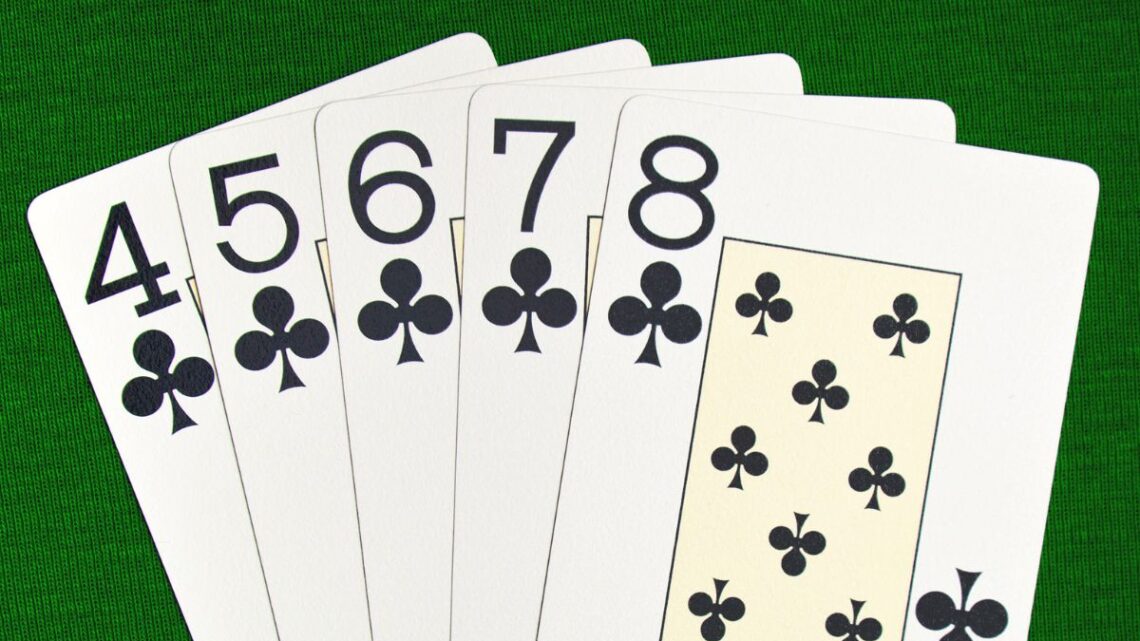
A straight flush stands as one of the most powerful hands you can make in poker. It consists of five consecutive cards all in the same suit, such as 9-8-7-6-5 of hearts, and ranks as the second-best hand in the game. Only a royal flush can beat it.

This hand combines the strength of both a straight and a flush into one elite combination. When you make a straight flush, you hold a near-unbeatable hand that wins against everything except a higher straight flush or the royal flush itself.
Understanding how this hand works will help you recognize it at the table and know how to play it for maximum value. You’ll learn what makes up a straight flush, how it compares to other hands, your chances of making one, and the best ways to use it when you’re lucky enough to have it.
What Is a Straight Flush?

A straight flush combines five consecutive cards of the same suit into one hand. It ranks as the second-strongest hand in poker, losing only to a royal flush.
Straight Flush Definition
A straight flush consists of five cards that follow in sequential order and share the same suit. For example, 5♦ 6♦ 7♦ 8♦ 9♦ is a straight flush in diamonds.
This hand must meet two requirements at once. All five cards need to be the same suit, and they must form a consecutive sequence. The ace can serve as either the highest card (in a 10-J-Q-K-A sequence) or the lowest card (in an A-2-3-4-5 sequence).
When you hold a straight flush, you have one of the rarest hands in poker. The highest possible straight flush is called a royal flush, which uses 10-J-Q-K-A of the same suit.
Composition of a Straight Flush
Your straight flush needs exactly five cards in numerical order from the same suit. The suit can be hearts, diamonds, clubs, or spades.
Here are some examples of valid straight flushes:
- 3♣ 4♣ 5♣ 6♣ 7♣ (seven-high straight flush)
- 8♠ 9♠ 10♠ J♠ Q♠ (queen-high straight flush)
- 6♥ 7♥ 8♥ 9♥ 10♥ (ten-high straight flush)
The highest card in your sequence determines the strength of your straight flush. A king-high straight flush beats a queen-high straight flush. If two players both have a straight flush, the one with the higher top card wins the pot.
Straight Flush vs. Straight and Flush
A straight contains five consecutive cards of mixed suits. A flush contains five cards of the same suit in any order. A straight flush combines both patterns into one hand.
When you make a flush in poker, your cards share the same suit but don’t need to be in order. A straight requires sequential cards but allows different suits. The straight flush is much stronger because it satisfies both conditions simultaneously.
The ranking hierarchy places a straight flush above both a regular straight and a regular flush. You will make a flush far more often than a straight flush. The chances of getting dealt a straight flush are approximately 0.028%, making it roughly 36 times rarer than a regular flush.
Straight Flush in Poker Hand Rankings

A straight flush holds the second-highest position in poker hand rankings, trailing only the royal flush. Understanding where this hand fits among all possible poker hands helps you make better betting decisions and recognize the true strength of your cards.
Position of Straight Flush in Hand Rankings
The straight flush ranks as the second-best possible hand you can make in poker. Only a royal flush beats it. This means your straight flush will defeat every other poker hand, including four of a kind, full house, flush, straight, three of a kind, two pair, one pair, and high card.
When you hold a straight flush, you have five consecutive cards all in the same suit. For example, 7-8-9-10-J of spades forms a straight flush. The hand combines the sequential nature of a straight with the suited requirement of a flush, making it extremely rare and powerful.
The complete poker hand rankings from strongest to weakest are:
- Royal Flush
- Straight Flush
- Four of a Kind
- Full House
- Flush
- Straight
- Three of a Kind
- Two Pair
- One Pair
- High Card (No Pair)
Royal Flush as the Highest Straight Flush
A royal flush is actually a specific type of straight flush. It consists of 10-J-Q-K-A all in the same suit. This represents the highest possible straight flush poker hand you can make.
The royal flush stands alone at the top because it contains the highest sequential cards possible. While other straight flushes might end with a 9, 10, or lower card, the royal flush always ends with an ace. This distinction makes it unbeatable in standard poker games.
If two players both have a straight flush, the one with the higher-ranking cards wins. A straight flush ending in a queen beats one ending in a nine. The royal flush wins all straight flush matchups because no cards rank higher than 10 through ace.
Comparisons with Other Poker Hands
Your straight flush poker hand beats four of a kind despite four matching cards seeming strong. The rarity and sequential suited nature of the straight flush gives it superior ranking. Four queens lose to 6-7-8-9-10 of hearts.
A full house combines three of a kind with one pair, but it ranks three positions below a straight flush. Similarly, a regular flush contains five suited cards without sequential order, placing it four spots lower in hand rankings. A straight features five consecutive cards of mixed suits, ranking even lower at sixth place.
The gap between a straight flush and hands like three of a kind, two pair, or one pair is substantial. These lower-ranking hands appear much more frequently in actual gameplay. When you hold a straight flush poker hand, you can bet confidently knowing only a royal flush can beat you.
How to Make a Straight Flush
You need five consecutive cards of the same suit to make a Straight Flush. This hand forms through your hole cards combining with community cards, or sometimes appears entirely on the board.
Examples of Straight Flushes
A Straight Flush requires exact specifications. You must hold five sequential cards that all share the same suit.
Here are valid examples:
- 5♠ 6♠ 7♠ 8♠ 9♠ (Nine-high Straight Flush in spades)
- 8♥ 9♥ 10♥ J♥ Q♥ (Queen-high Straight Flush in hearts)
- 2♣ 3♣ 4♣ 5♣ 6♣ (Six-high Straight Flush in clubs)
- 9♦ 10♦ J♦ Q♦ K♦ (King-high Straight Flush in diamonds)
The ace can work as either high or low. You can make A♠ 2♠ 3♠ 4♠ 5♠ (five-high) or 10♥ J♥ Q♥ K♥ A♥ (Royal Flush).
Invalid combinations include:
- 5♠ 6♥ 7♠ 8♠ 9♠ (mixed suits)
- 5♠ 6♠ 8♠ 9♠ 10♠ (missing the 7 for sequence)
- 5♠ 6♠ 7♠ 8♠ 8♣ (duplicate rank breaks sequence)
Suited Connectors and Other Draws
Suited connectors give you the best starting chance at a Straight Flush. These are hole cards like 8♥ 9♥ or J♠ Q♠ that sit next to each other in rank and share a suit.
A pocket pair cannot make a Straight Flush because you need five different ranks in sequence. If you hold 7♦ 7♦, you have duplicate ranks that prevent the consecutive pattern required.
Your draws develop through the streets:
Straight Flush Draw Types:
- Open-ended straight flush draw (8 outs to complete)
- Gutshot straight flush draw (1 out to complete)
- One-card straight flush draw (needs specific card)
Starting with suited connectors like 9♣ 10♣ gives you multiple ways to connect. You can catch running cards or hit parts of your draw on the flop.
Community Cards and Possibilities
The community cards determine if your Straight Flush becomes possible. You need the board to cooperate with your hole cards.
Complete Straight Flush scenarios:
| Your Hole Cards | Community Cards | Result |
|---|---|---|
| 9♠ 10♠ | J♠ Q♠ K♠ 3♥ 7♦ | King-high Straight Flush |
| 5♦ 6♦ | 4♦ 7♦ 8♦ A♣ 2♥ | Eight-high Straight Flush |
| A♥ 2♥ | 3♥ 4♥ 5♥ K♠ 9♦ | Five-high Straight Flush |
Sometimes the board itself contains four parts of a Straight Flush. If you hold the missing card in that suit, you complete it. With 6♣ 7♣ 8♣ 9♣ on board and 10♣ in your hand, you have a ten-high Straight Flush.
You can also make trips or a set while drawing to a Straight Flush, but these hands rank much lower. Focus on the flush and straight possibilities together when evaluating your hand strength.
Straight Flush Odds and Probability
A straight flush occurs roughly once every 72,193 hands in five-card poker, making it one of the rarest hands you can make. The exact probability changes based on the poker variant you play and which street you’re on during a hand.
Probability of Hitting a Straight Flush
When you receive five random cards from a standard 52-card deck, your chance of making a straight flush is 0.00139%. This translates to odds of 72,192 to 1 against you.
There are only 40 possible straight flush combinations in a deck. Nine straight flushes exist in each of the four suits, plus one royal flush per suit. Your odds of being dealt a specific straight flush, like 5-6-7-8-9 of hearts, drop to 1 in 649,740.
In any poker room, you might play thousands of hands before seeing this premium holding. Online poker players who multi-table can expect to see straight flushes more frequently simply because they play more hands per hour.
Odds in Texas Hold’em and Omaha
Texas Hold’em gives you seven total cards to work with when you combine your two hole cards with five community cards. This improves your odds compared to five-card draw.
In Omaha, you get four hole cards but must use exactly two of them with three community cards. Your chances of making a straight flush increase slightly because you start with more cards. However, your opponents also have better odds to make strong hands, which creates more action but also more danger.
Both games require you to see all five community cards to maximize your straight flush odds. Most players who hit this hand do so by the river after seeing all available cards.
Straight Flush Odds by Street (Flop, Turn, River)
Your odds change dramatically as each card hits the board. On the flop, if you hold two suited connectors and the flop brings two more cards to your straight flush, you have about a 4.3% chance to complete it by the river.
Here’s how your odds progress:
| Street | Cards to Come | Probability | Odds Against |
|---|---|---|---|
| Flop | 2 cards | ~4.3% | 22:1 |
| Turn | 1 card | ~2.1% | 46:1 |
When you have a straight flush draw on the flop, you typically have 15 outs (9 flush outs plus 6 straight outs, minus 2 that overlap). The turn gives you one more chance to hit. If you miss the turn, your river odds drop to around 2.1% because only one card remains.
Most straight flushes require you to have suited connectors or one-gappers in your starting hand. Without proper starting cards, your flop odds become nearly impossible.
What Beats a Straight Flush and Tiebreakers
A straight flush is one of the strongest hands in poker, losing to only one hand type. When two players both have a straight flush, the highest-ranking card determines the winner.
Royal Flush vs. Straight Flush
Only a royal flush beats a straight flush in poker. A royal flush is the highest possible straight flush, consisting of ace, king, queen, jack, and ten all of the same suit.
If you hold any other straight flush, a royal flush will always win the pot. For example, if you have a king-high straight flush (K-Q-J-10-9 of the same suit), you will lose to a royal flush.
No other hands can beat a straight flush. Four-of-a-kind (also called quads), a full house (also called a boat), and all lower-ranking hands lose to any straight flush. This makes a straight flush the second-best possible hand you can make in standard poker games.
Tiebreakers with Straight Flushes
When two or more players have a straight flush, the hand with the highest card wins. You compare the top card in each sequence to determine which straight flush is stronger.
For example, a queen-high straight flush (Q-J-10-9-8) beats a jack-high straight flush (J-10-9-8-7). If both players have the same high card, you move to the next card down. However, since a straight flush requires five consecutive cards, if the highest card matches, all five cards will be identical.
When all five cards are the same, the pot splits evenly between players. Suits do not break ties in poker, so a diamond straight flush and a heart straight flush of the same rank have equal value.
Straight Flush vs. Lower Hands
A straight flush beats every other standard poker hand except a higher straight flush or royal flush. You will win against four-of-a-kind, full houses, regular flushes, straights, and all weaker hands.
Four-of-a-kind might seem strong, but it cannot beat your straight flush. The same applies to a full house, which loses despite being a powerful hand. A regular flush or straight also loses to a straight flush because you have both requirements: all cards of the same suit and in consecutive order.
Strategy for Playing a Straight Flush
When you hold a straight flush, your main goals are to build the pot size while keeping opponents involved and adjusting your approach based on the specific poker game you’re playing. The key is balancing aggression with deception to maximize your winnings from this powerful hand.
Optimal Betting with a Straight Flush
Your betting strategy should focus on building the pot without scaring opponents away. Start with smaller bets on early streets to keep multiple players in the hand. This approach works because most opponents won’t suspect you have such a strong hand.
You should increase your bet sizes gradually as more cards appear on the board. This pattern looks natural and mimics how someone might bet with a good but not unbeatable hand. Avoid making huge bets right away, as this typically forces weaker hands to fold immediately.
Consider the board texture when you decide your bet amounts. If the board shows obvious straight or flush possibilities, your opponents may call larger bets because they think you’re bluffing. On drier boards, you need to bet smaller amounts to keep opponents interested in the pot.
Extracting Maximum Value
You extract maximum value by paying attention to your opponents’ playing styles and stack sizes. Against aggressive players, you can use check-raises to let them bet first, then raise their bets to build a bigger pot. This tactic works because aggressive players often bet when you show weakness.
Against cautious players, you need to make value bets on every street. These players will fold to large bets, so keep your bets at 40-60% of the pot size. This amount looks reasonable enough for them to call with decent hands.
Key value extraction tactics:
- Check-raise against aggressive opponents
- Small value bets against tight players
- Overbets when the board is scary and opponents have strong hands
- Slow play only when you’re certain opponents will bet
Your position at the table matters for value extraction. In early position, you can check to induce bluffs. In late position, you have more information about opponent actions and can size your bets more accurately.
Straight Flush Strategy in Various Poker Games
Your straight flush strategy changes based on which poker game you’re playing. In Texas Hold’em, you often have drawing opportunities that develop into straight flushes on the turn or river. Play these draws cautiously with small bets until you complete your hand.
In Omaha, straight flushes occur more frequently because you have four hole cards instead of two. You should be more aggressive with your straight flush here, as opponents likely hold strong hands too. The pot limit betting structure in Pot Limit Omaha means you need to build the pot earlier in the hand.
In Seven Card Stud, your straight flush is visible to opponents as cards appear face-up on the table. You need to bet aggressively before your hand becomes obvious. Once opponents see four suited connected cards, they’ll likely fold everything except very strong hands.
For tournament play versus cash games, adjust your aggression level based on stack sizes and blind levels. In tournaments with shorter stacks, push all-in more readily with your straight flush. In deep-stacked cash games, take time to extract value across multiple betting rounds.
Frequently Asked Questions
Straight flushes raise many questions about probability, rankings, and specific game applications. The odds of making this hand vary depending on the game format, and understanding how it compares to other hands helps you make better decisions at the table.
What are the odds of being dealt a straight flush in a game of poker?
Your chances of being dealt a straight flush with five random cards are 72,192 to 1 against. This translates to a 0.00139% probability.
If you start with suited connectors in Texas Hold’em, your odds improve to 3,590 to 1 against (0.0279%). Suited connectors are two cards of the same suit in sequence, like 8♠ 9♠.
Starting with suited one-gappers or two-gappers gives you longer odds. This is why selecting your starting hands carefully matters when you’re trying to make strong hands.
How does a straight flush rank compared to other poker hands?
A straight flush ranks as the second-best hand in poker. Only a royal flush can beat it.
This hand beats four-of-a-kind, full houses, regular flushes, and straights. When two players both have straight flushes, the one with the highest card in the sequence wins.
What is the difference between a straight flush and a royal flush?
A royal flush is a specific type of straight flush. It consists of 10-J-Q-K-A, all in the same suit.
Every other straight flush uses lower cards in sequence. For example, 5♥ 6♥ 7♥ 8♥ 9♥ is a straight flush, but it’s not a royal flush because it doesn’t contain the highest possible cards.
The royal flush is unbeatable in standard poker games. A regular straight flush can lose to a higher straight flush or a royal flush.
Can an Ace be used as a low card in a straight flush sequence?
Yes, you can use an Ace as a low card in a straight flush. The sequence A-2-3-4-5 of the same suit forms a valid straight flush.
This is called a wheel or bicycle in poker terminology. It’s the lowest possible straight flush you can make.
You cannot wrap around from King to Ace to 2. Sequences like K-A-2-3-4 don’t count as valid straights or straight flushes.
What is the probability of drawing a straight flush in blackjack?
You cannot draw a straight flush in blackjack. Blackjack doesn’t use poker hand rankings as part of its standard gameplay or scoring system.
Blackjack focuses on reaching a hand value of 21 or getting closer to 21 than the dealer. Suits and sequences don’t affect the outcome of standard blackjack hands.
Some blackjack variants include side bets that pay out for poker hands. These optional bets are separate from the main game and have their own probability calculations.
In Yu-Gi-Oh, what are the abilities and effects of a “Straight Flush”?
Straight Flush is a Trap Card in Yu-Gi-Oh that requires you to control five monsters with consecutive Levels. When activated, you can draw two cards from your deck.
The card’s effect helps you gain card advantage if you can meet its activation requirement. Setting up five monsters with sequential Levels takes planning and the right deck construction.
This card sees limited competitive play because the activation condition is difficult to achieve consistently. You need specific deck strategies focused on Level manipulation to make it work effectively.