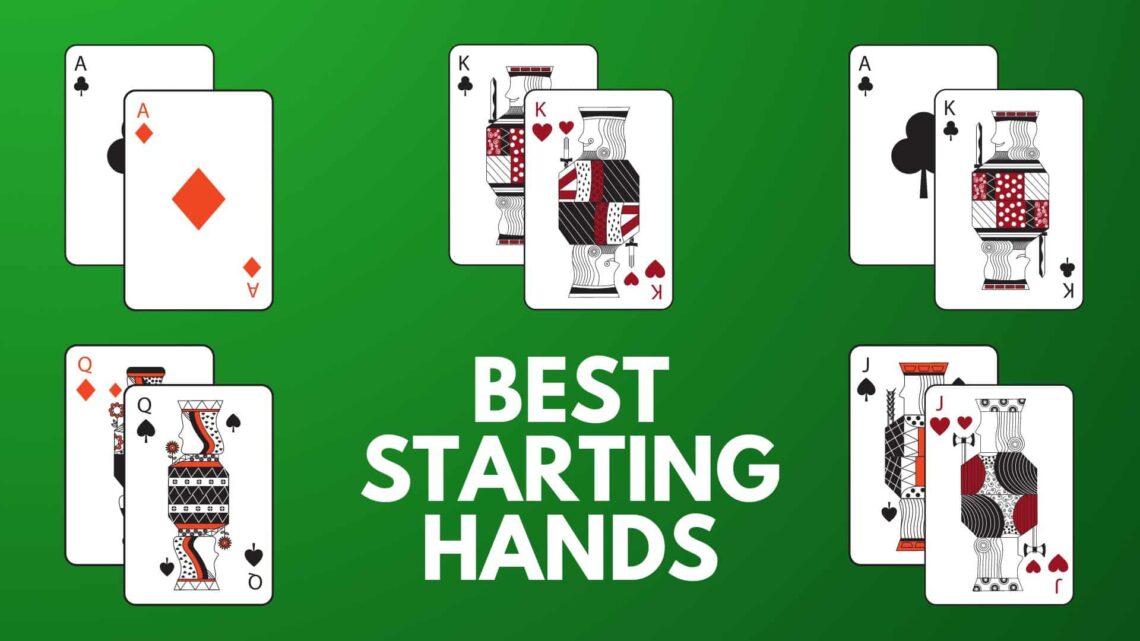
Winning at poker starts with knowing which hands beat which. In Texas Hold’em, poker hands are ranked from the strongest (Royal Flush) to the weakest (High Card), and understanding these rankings is the first step to playing successfully. Without this basic knowledge, you can’t make smart decisions at the table.
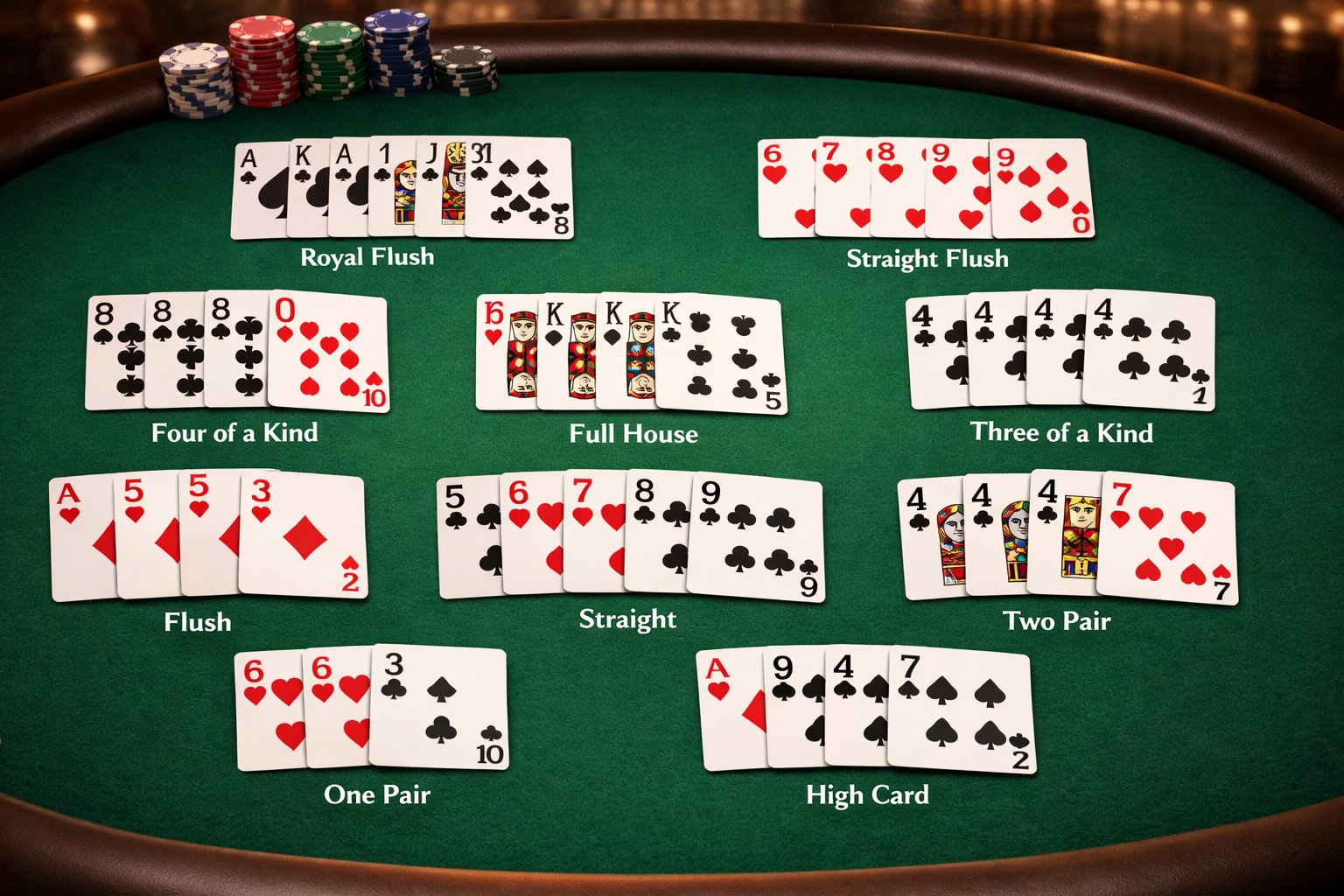
This guide breaks down everything you need to know about poker hand rankings. You’ll learn the official hand hierarchy, how hands are formed using your hole cards and community cards, and which starting hands give you the best chance to win.
We’ll also cover the math behind poker hands, including odds and probabilities that help you understand how often certain hands appear. By the end of this article, you’ll have a solid foundation for making better decisions before and after the flop.
Official Poker Hand Rankings in Texas Hold’em
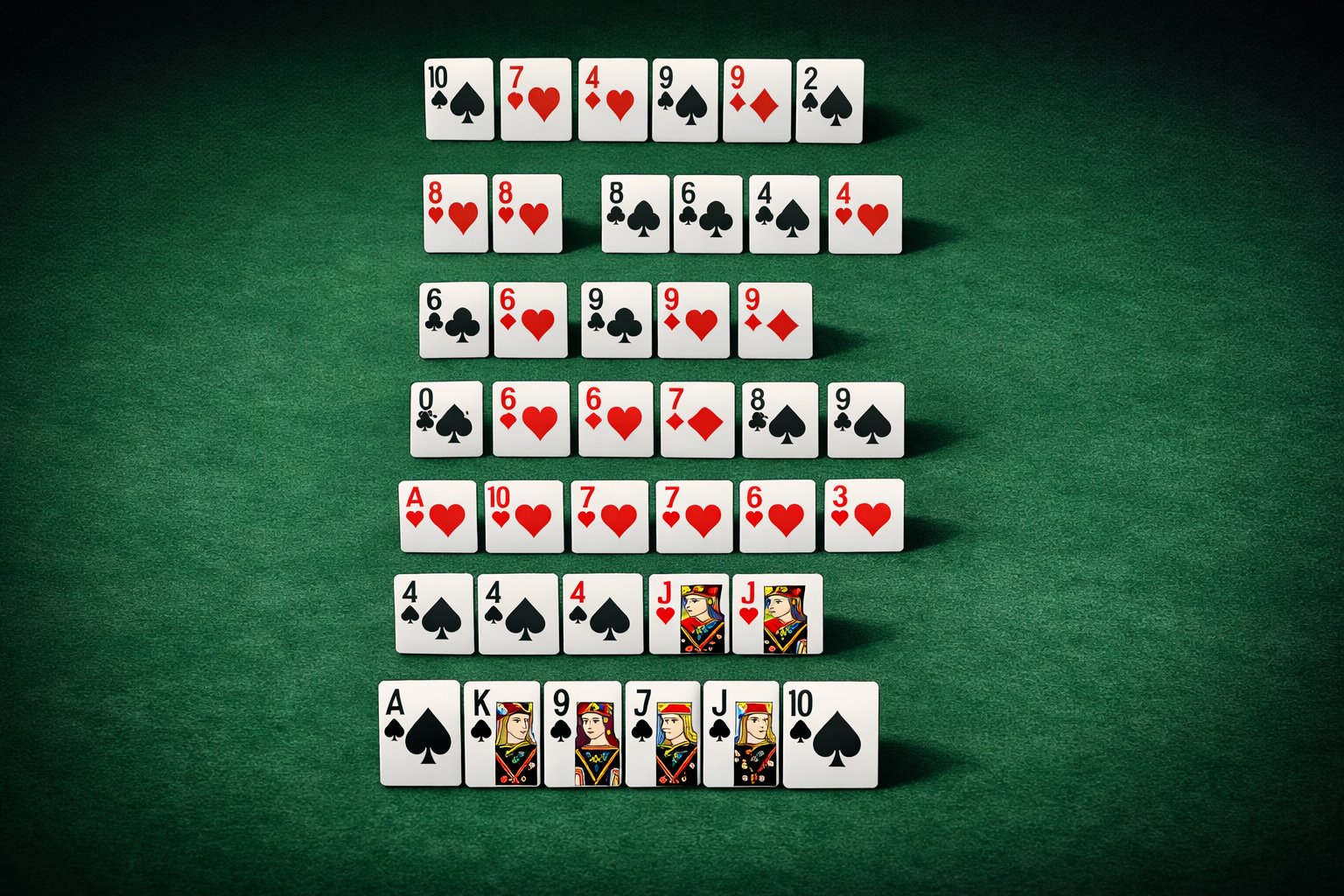
Texas Hold’em uses a standard system of ten poker hand rankings that determines which player wins at showdown. Every hand falls into one of these categories, from the rare royal flush down to high card.
Poker Hands List in Order
The official poker hand rankings list ten hands from strongest to weakest. A royal flush sits at the top as the best possible hand. It contains an ace, king, queen, jack, and ten all in the same suit.
A straight flush ranks second and consists of five consecutive cards in the same suit. Four-of-a-kind comes third, featuring four cards of the same value. A full house ranks fourth, combining three cards of one value with two cards of another value.
The fifth-ranked hand is a flush, which has five cards of the same suit in any order. A straight ranks sixth with five consecutive cards of mixed suits. Three-of-a-kind sits in seventh place with three matching cards.
Two pair ranks eighth, containing two different pairs plus one unmatched card. One pair takes ninth place with just two matching cards. High card is the weakest hand, used when you can’t make any other combination.
What Beats What in Poker
Each poker hand beats all hands ranked below it. A royal flush beats every other hand without exception. A straight flush defeats four-of-a-kind, full house, flush, straight, three-of-a-kind, two pair, one pair, and high card.
Four-of-a-kind wins against full house, flush, straight, three-of-a-kind, two pair, one pair, and high card. A full house beats flush, straight, three-of-a-kind, two pair, one pair, and high card. A flush defeats straight, three-of-a-kind, two pair, one pair, and high card.
A straight beats three-of-a-kind, two pair, one pair, and high card. Three-of-a-kind wins against two pair, one pair, and high card. Two pair defeats one pair and high card. One pair only beats high card.
Poker Hands Chart and Cheat Sheet
A poker hand chart displays all ten hands in visual format for quick reference. The chart typically shows example cards for each hand type along with its rank number.
| Rank | Hand Name | Example |
|---|---|---|
| 1 | Royal Flush | A♦ K♦ Q♦ J♦ 10♦ |
| 2 | Straight Flush | 9♠ 8♠ 7♠ 6♠ 5♠ |
| 3 | Four-of-a-Kind | 8♥ 8♦ 8♣ 8♠ 3♦ |
| 4 | Full House | K♠ K♥ K♦ 5♣ 5♥ |
| 5 | Flush | Q♣ 10♣ 7♣ 5♣ 2♣ |
| 6 | Straight | 10♥ 9♦ 8♠ 7♣ 6♥ |
| 7 | Three-of-a-Kind | 7♦ 7♠ 7♣ K♥ 2♠ |
| 8 | Two Pair | J♥ J♣ 4♦ 4♠ A♥ |
| 9 | One Pair | 10♦ 10♠ A♣ 8♥ 3♦ |
| 10 | High Card | A♠ J♦ 9♣ 5♥ 2♠ |
New players should keep this chart nearby during their first games. You can download printable versions online to use at home or study between sessions.
Ranking Criteria and Tie Breakers
When two players have the same hand type, specific rules determine the winner. For pairs, three-of-a-kind, and four-of-a-kind, the higher card value wins. A pair of aces beats a pair of kings.
If players have identical pairs, the highest side card (kicker) breaks the tie. The second-highest kicker decides if the first kickers match, and so on. For two pair hands, the highest pair wins first, then the second pair, then the kicker.
In a full house tie, the three-of-a-kind value matters first. Three aces with two kings beats three kings with two aces. For flushes, compare the highest card, then the second highest, continuing down until you find a difference.
Straight ties go to the hand with the highest top card. An ace-high straight beats a king-high straight. All suits rank equally in Texas Hold’em, so a heart flush and a spade flush have the same value.
Detailed Breakdown of Poker Hands
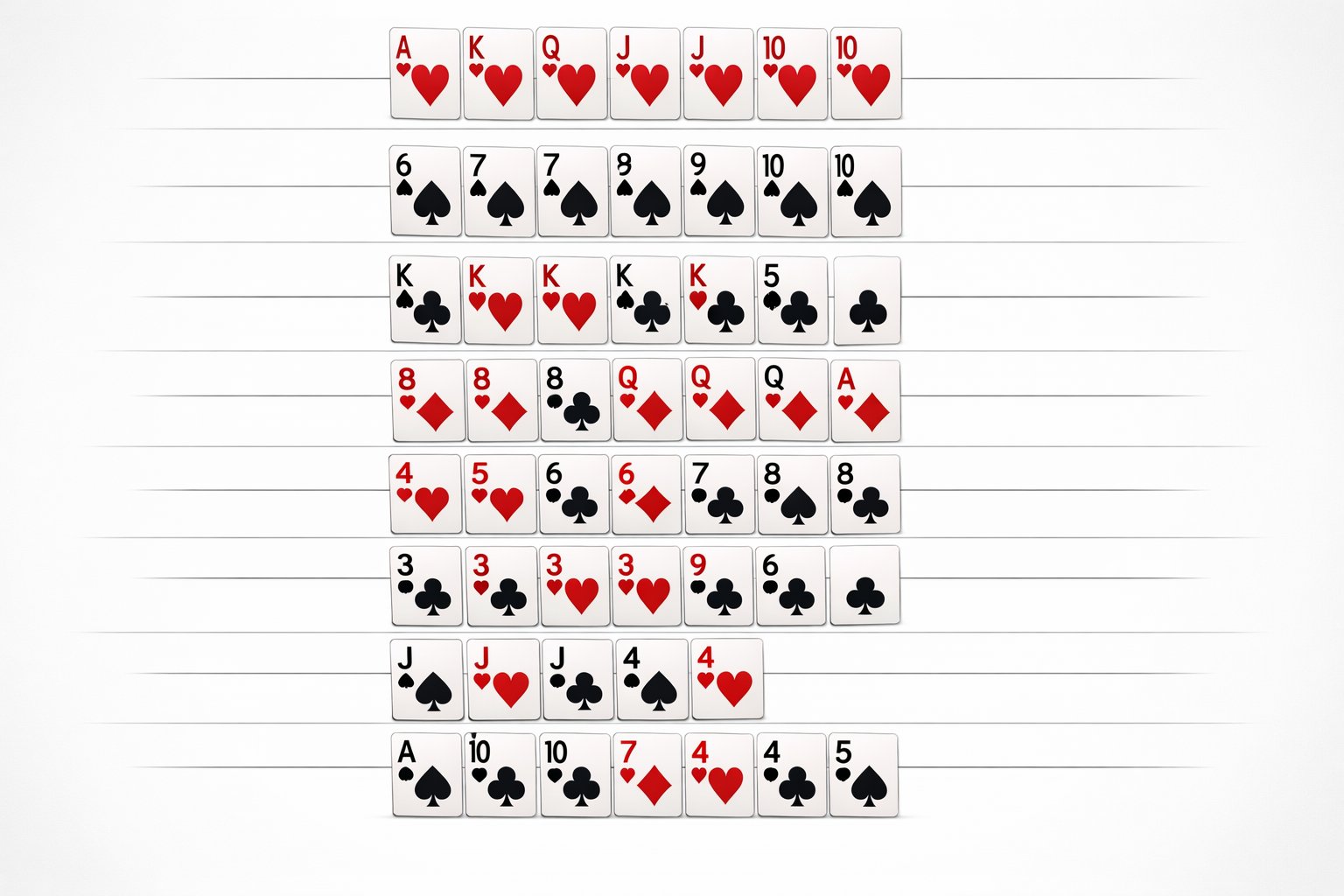
The strongest poker hands follow a clear ranking system based on how rare they are to make. A royal flush sits at the top as the absolute best hand, while a straight flush, four of a kind, and full house round out the most powerful winning poker hands you can get.
Royal Flush in Detail
A royal flush is the best poker hand you can possibly make. It consists of A-K-Q-J-10, all in the same suit.
You cannot beat this hand. Ever. If you make a royal flush, you have the strongest possible combination in poker.
All four suits can make a royal flush. You could have A♠ K♠ Q♠ J♠ 10♠ in spades, or the same sequence in hearts, diamonds, or clubs. The suit doesn’t matter for the strength of the hand since all royal flushes tie with each other.
The odds of making a royal flush are extremely low. In Texas Hold’em, you’ll only see this hand about once every 30,000 hands. This rarity makes it the most valuable hand in poker.
Straight Flush: How It Works
A straight flush is five cards in numerical order, all in the same suit. Examples include 9♥ 8♥ 7♥ 6♥ 5♥ or K♦ Q♦ J♦ 10♦ 9♦.
The highest card in your straight flush determines its strength. An ace-high straight flush is a royal flush. A king-high straight flush beats a queen-high straight flush, and so on down the line.
If two players both have a straight flush, the one with the higher top card wins the pot. A straight flush with 9-8-7-6-5 loses to one with 10-9-8-7-6.
The ace can play low in a straight flush. You can make A-2-3-4-5 of the same suit, called a wheel or five-high straight flush. This is the lowest possible straight flush.
Four of a Kind (Quads)
Four of a kind means you have all four cards of the same rank. You might hold 8♠ 8♥ 8♦ 8♣ plus one other card, or Q♠ Q♥ Q♦ Q♣ with a kicker.
Players often call this hand “quads.” Higher-ranked quads beat lower-ranked quads. Four kings beat four jacks. Four threes beat four twos.
When two players both have quads, the fifth card (called the kicker) breaks the tie. If one player has 7-7-7-7-A and another has 7-7-7-7-K, the ace kicker wins.
In Texas Hold’em with community cards, both players sometimes share the same quads on the board. The player with the higher hole card as a kicker takes the pot.
Full House Explained
A full house contains three cards of one rank and two cards of another rank. Common examples are K-K-K-8-8 or 5-5-5-J-J.
The three-of-a-kind portion determines the strength of your full house. A full house with three queens beats a full house with three jacks, regardless of the pair. Queens full of twos (Q-Q-Q-2-2) beats jacks full of aces (J-J-J-A-A).
If two players have the same three-of-a-kind, the pair breaks the tie. Three eights with a pair of kings (8-8-8-K-K) beats three eights with a pair of queens (8-8-8-Q-Q).
Full houses rank very high among poker hands. Only four of a kind, straight flushes, and royal flushes can beat them.
Understanding Middle and Lower-Ranked Hands
The middle-ranked hands like flushes and straights win more pots than you might expect, while lower hands such as three of a kind, two pair, and one pair require careful play to maximize value. These hands form the backbone of most winning poker sessions.
Flush: Strong Five Card Hands
A flush consists of five cards of the same suit in any order. You don’t need the cards to be in sequence. For example, holding the 2, 5, 9, Jack, and King of hearts creates a flush.
When two players both have a flush, the highest-ranked card determines the winner. If your flush is King-high and your opponent’s is Queen-high, you win the pot. When the highest cards match, you compare the second-highest cards, then the third, and so on down the line.
Flushes rank above straights but below full houses. This makes them powerful hands that win most showdowns. In Texas Hold’em, you’ll make a flush roughly once every 500 hands when counting all five community cards.
The suit itself doesn’t matter for hand strength. A club flush has the same value as a diamond flush. Only the ranks of your five cards determine who wins.
Straight: Sequential Strength
A straight contains five unsuited cards in sequence. The cards must follow consecutive ranks like 7-8-9-10-Jack, but they can be different suits. This distinguishes straights from straight flushes.
The highest card in your sequence determines your straight’s strength. A King-high straight (9-10-Jack-Queen-King) beats a Queen-high straight (8-9-10-Jack-Queen). An Ace can function as either the highest card (10-Jack-Queen-King-Ace) or the lowest card (Ace-2-3-4-5).
The Ace-low straight (often called a wheel) is the weakest possible straight. It loses to any other straight, including 2-3-4-5-6. When two players have straights with the same high card, they split the pot.
Straights rank below flushes and above three of a kind. You’ll complete a straight approximately once every 250 hands in Texas Hold’em.
Three of a Kind and Sets
Three of a kind means you have three cards of the same rank plus two unrelated cards. In Texas Hold’em, you can make this hand two ways: using one hole card with two community cards, or using both hole cards with one community card (called a set).
Sets are stronger than trips because they’re harder for opponents to detect. When you hold pocket 8s and an 8 appears on the board, your opponents won’t see the danger as easily.
If multiple players have three of a kind, the highest rank wins. Three Queens beat three Jacks. When players share the same three of a kind through community cards, the highest side card (kicker) determines the winner. Three 7s with an Ace kicker beats three 7s with a King kicker.
Your two remaining cards matter more than you think. They can make the difference between winning and splitting the pot.
Two Pair and One Pair
Two pair contains two cards of one rank, two cards of another rank, and one unrelated card. When comparing two pair hands, the highest pair decides the winner first. Aces and 3s beats Kings and Queens because Aces are higher.
If the top pairs match, you compare the second pairs. When both pairs are identical, the fifth card (kicker) determines who wins. Two pair beats one pair but loses to three of a kind.
One pair is simply two cards of matching rank plus three additional cards. Most winning hands at showdown are pairs or better. The pair’s rank matters most, but kickers become critical when players hold the same pair.
A pair of 10s with an Ace kicker beats a pair of 10s with a King kicker. You need to track all five cards in your hand, not just the pair itself.
Pocket Pairs and Premium Starting Hands
Premium starting hands give you the best chance to win before any community cards appear. High pocket pairs and strong ace combinations dominate early position play and form the core of winning poker strategy.
Pocket Aces, Kings, Queens and Jacks
Pocket aces stand as the strongest starting hand in Texas Hold’em. You win roughly 85% of the time against any single opponent with this hand. You should raise or re-raise with pocket aces from any position at the table.
Pocket kings rank second in strength and win about 82% against a single opponent. The main concern with kings is running into aces. You play them aggressively but remain cautious if an ace appears on the flop.
Pocket queens win approximately 80% against one opponent. These cards play well but become vulnerable when overcards hit the board. You need to assess your opponents’ actions carefully when kings or aces appear.
Pocket jacks win around 78% against a single opponent. This hand performs well but faces more difficult decisions than higher pairs. You often face tough choices when any overcard lands on the flop or turn.
Ace King Suited and Offsuit
Ace king suited wins about 67% against a random hand heads-up. The suited version performs slightly better than offsuit because you can make the nut flush. You should raise with this hand from any position.
Ace king offsuit still ranks among the top starting hands despite lacking flush potential. You win approximately 65% of the time against one opponent. This hand benefits from aggressive play to build the pot or force weaker hands to fold.
Both versions struggle against pocket pairs before the flop. You need to hit an ace or king to make a strong pair. Your position at the table influences how aggressively you play these hands after the flop.
Other Premium Starters: Tens and Nines
Pocket tens win about 75% against one opponent and represent the dividing line between premium and mid-range pairs. You can raise from most positions but should proceed carefully against heavy action from early position players.
These hands work best when you can see a flop cheaply or thin the field with a raise. Three or more opponents significantly reduce your winning chances. You face difficult decisions when overcards appear on the board.
Pocket nines win roughly 72% heads-up and require more careful play than higher pairs. You often need to hit a set on the flop to continue with confidence. Position becomes more important with this hand since you’ll face overcards frequently.
Suited Connectors and Speculative Hands
Ace queen suited and ace jack suited offer strong potential for straights and flushes. These hands win 66% and 65% of the time respectively against random opponents. You play them for their ability to make multiple strong combinations.
Suited connectors like jack-ten suited or nine-eight suited win less often but create opportunities for straights and flushes. You typically need good pot odds to play these hands profitably. Your position matters significantly with speculative hands since you need to see cheap flops.
These hands perform better in multi-way pots where implied odds increase. You fold them quickly when you miss the flop completely. The suited versions play better than offsuit because they add flush possibilities to straight potential.
How Poker Hands Are Made in Texas Hold’em
In Texas Hold’em, you combine your private cards with shared cards on the table to create the strongest possible five-card combination. Understanding how to use both sets of cards effectively determines whether your hand beats your opponents at showdown.
Community Cards and Hole Cards
When you play poker, you receive two private cards called hole cards that only you can see. Five community cards are then dealt face-up in the center of the table in three stages: the flop (three cards), the turn (one card), and the river (one card).
You can use any combination of your two hole cards and the five community cards to make your final hand. This means you might use both hole cards, one hole card, or even no hole cards at all.
The flexibility in how you combine these seven total cards gives Texas Hold’em its strategic depth. Your hole cards might pair with community cards to make strong hands like two pair or a set, or the community cards alone might form your best five-card hand.
Making the Best Five-Card Hand
You must select exactly five cards from the seven available to create your final poker hand. Your goal is to make the best poker hands possible from any combination of your hole cards and community cards.
For example, if you hold Ace-King and the board shows Ace-King-Queen-Jack-Ten, you use both your hole cards plus three community cards to make a straight. If you hold pocket sixes and the board shows 6-9-9-4-2, you have a full house using both hole cards and three community cards.
Sometimes the five community cards form a better hand than anything you can make with your hole cards. In this case, you “play the board” and your hand is only as strong as those five shared cards.
Importance of Kickers
A kicker is the highest card in your hand that doesn’t directly contribute to your main hand ranking. Kickers determine the winner when two players have the same ranked hand.
If you hold Ace-King and your opponent holds Ace-Queen, and the board shows Ace-7-4-2-9, you both have a pair of Aces. Your King kicker beats their Queen kicker, giving you the pot.
Kickers matter most with pairs, two pairs, and three of a kind. They don’t apply to straights, flushes, full houses, or four of a kind, where all five cards are part of the main hand. Playing hands with strong kickers increases your chances of winning when you make the same pair as your opponent.
Probability, Odds, and Hand Frequencies
Understanding the math behind poker hands helps you make better decisions at the table. The odds of being dealt specific hands vary widely, from common pairs to rare straight flushes.
Odds of Being Dealt Key Poker Hands
When you sit down at a Texas Hold’em table, the chances of being dealt each hand type are fixed by math. A Royal Flush appears roughly once every 30,939 hands dealt, making it about a 0.0032% chance. You’ll see a Straight Flush slightly more often at 0.027%.
Four of a Kind shows up in about 0.17% of hands. A Full House arrives more frequently at 2.6%, while a Flush appears in 3.0% of hands.
Here are the complete odds for all poker hands ranked from strongest to weakest:
| Hand | Probability | Frequency |
|---|---|---|
| Royal Flush | 0.0032% | 1 in 30,939 |
| Straight Flush | 0.027% | 1 in 3,589 |
| Four of a Kind | 0.17% | 1 in 594 |
| Full House | 2.6% | 1 in 38 |
| Flush | 3.0% | 1 in 33 |
| Straight | 4.6% | 1 in 22 |
| Three of a Kind | 4.8% | 1 in 21 |
| Two Pair | 23.5% | 1 in 4 |
| One Pair | 43.8% | 1 in 2 |
| High Card | 17.4% | 1 in 6 |
Poker Hands Probability Explained
The poker hands probability numbers show you’ll make One Pair in nearly 44% of your hands by the river. This makes it the most common showdown hand you’ll hold.
Two Pair forms in roughly 23.5% of hands, making it fairly common but still strong enough to win many pots. Combined, these two hand types account for about two-thirds of all poker hands you’ll play to showdown.
High Card hands appear in 17.4% of situations. When you don’t connect with the board at all, you’re left with just your highest card.
The mid-range hands like Three of a Kind (4.8%) and Straight (4.6%) happen often enough that you’ll see them regularly during play. Strong hands like Full House and Flush are uncommon enough that they usually win at showdown.
Relative Value of Hands
Raw probability tells only part of the story. A Flush ranks high in absolute terms, but its value drops significantly on a paired board where opponents could hold a Full House.
Pocket Aces win about 85% of the time heads-up but drop to roughly 50% against four opponents. More players in the hand means more chances someone will outdraw you.
Board texture changes everything. Top pair with an ace kicker is strong on a rainbow flop with no straight draws. That same hand becomes vulnerable on a board showing three hearts and connected cards. You need to adjust your play based on what hands your opponents could realistically hold given the community cards and betting action.
Practical Poker Strategy for Hand Selection
Strong hand selection separates winning players from those who consistently lose chips. Your ability to choose the right starting hands based on position and table dynamics directly impacts your long-term profitability in both live games and online poker.
Choosing Winning Poker Starting Hands
Premium pairs like AA, KK, and QQ should be played aggressively from any position. These hands win most showdowns and deserve raises to build the pot and narrow the field. JJ and TT are also strong but require more caution when facing significant action.
Big cards like AK and AQ give you two ways to win: making top pair or hitting a straight. AK performs well even without improvement because it dominates weaker ace-high hands. You should raise with these hands to take control of the pot.
Avoid common mistakes with weak holdings:
- Playing any ace regardless of kicker strength
- Overvaluing suited cards that don’t connect
- Calling raises with marginal pairs like 66 or 77
Suited connectors like JT♠ or 98♠ work best in multi-way pots where you can win big if you hit a straight or flush. These poker starting hands need the right price and table conditions to be profitable.
Adjusting to Position and Opponents
Your position at the table determines which hands are profitable to play. In early position, stick to premium hands because you’ll face action from multiple players behind you. You can’t afford to play speculative hands when six or seven opponents still need to act.
Late position gives you more flexibility in your poker strategy. You can play hands like KJ, QJ, and suited aces when the action folds to you. You have more information about other players’ strength and can steal pots with raises.
Position-based adjustments:
- Early position: Play only the top 15% of hands
- Middle position: Expand to include pairs down to 88 and suited broadway cards
- Late position: Add suited connectors and more ace-high combinations
Table dynamics matter as much as position. Tighten your range against aggressive players who raise frequently. Widen it against passive opponents who fold too often to pressure.
Using Poker Hands to Guide Strategy
Your starting hand strength should dictate your betting approach throughout the hand. Premium pairs need protection through raises to reduce the number of opponents who see the flop. More players mean more chances someone connects with the board and beats you.
Drawing hands like suited connectors perform better with more callers in the pot. The potential payoff justifies the risk when you can win a large pot relative to your investment. In online poker, where you can play more hands per hour, maintaining strict hand selection discipline becomes even more important.
Strategic guidelines by hand type:
| Hand Type | Primary Goal | Best Situation |
|---|---|---|
| Premium pairs | Win big pots | Any position, heads-up or small field |
| Big aces | Dominate opponents | Raised pots, position advantage |
| Suited connectors | Hit hidden hands | Multi-way pots, deep stacks |
| Small pairs | Flop sets | Cheap entry, implied odds |
Adjust your poker starting hands based on stack sizes. Short stacks need hands that win without improvement. Deep stacks allow you to play more speculative holdings that can make strong combinations.
Frequently Asked Questions
New poker players often have similar questions about hand strength, starting cards, and basic gameplay. The answers below cover the most important information you need to start playing Texas Hold’em with confidence.
What are the top starting hands in Texas Hold’em?
Pocket aces (AA) is the strongest starting hand in Texas Hold’em. This hand wins more often than any other two-card combination.
Pocket kings (KK) and pocket queens (QQ) are the second and third best starting hands. Ace-king suited (AKs) ranks as the fourth strongest starting hand because it can make powerful pairs, straights, and flushes.
The top 20 starting hands include all pocket pairs from jacks down to nines, plus strong ace combinations like ace-queen and ace-jack. Suited connectors like king-queen suited and jack-ten suited also make the list because they can form multiple strong hands.
How are hands ranked in Texas Hold’em from highest to lowest?
The royal flush sits at the top as the best possible hand. It consists of ace, king, queen, jack, and ten all in the same suit.
A straight flush comes next, which is five cards in sequence all of the same suit. Four of a kind ranks third and means you have four cards of the same value.
A full house contains three cards of one value and two cards of another value. The flush includes any five cards of the same suit, while a straight has five cards in sequence of mixed suits.
Three of a kind beats two pair, which beats one pair. High card is the lowest ranking hand when you don’t make any of the other combinations.
Can you explain the basic rules of Texas Hold’em?
Each player receives two private cards face down. These cards are called hole cards and only you can see them.
Five community cards get dealt face up in the center of the table. These cards are shared by all players to make their best five-card hand.
The community cards come out in three stages: the flop (three cards), the turn (one card), and the river (one card). Between each stage, players can bet, check, raise, or fold.
The player with the best five-card hand using any combination of their two hole cards and the five community cards wins the pot. You can use both hole cards, one hole card, or neither of your hole cards to make your final hand.
What is the probability of getting a specific hand in poker?
A royal flush appears approximately once every 649,740 hands. This makes it the rarest hand in poker.
You’ll get dealt a straight flush about once every 72,193 hands. Four of a kind happens roughly once in 4,165 hands.
A full house occurs about once every 694 hands, while a flush appears once every 509 hands. You’ll make a straight approximately once in 255 hands.
Pocket aces get dealt once every 221 hands. Any pocket pair appears about once every 17 hands, making them relatively common starting hands.
Where can I find a chart of poker hands ranked?
Most poker websites offer free downloadable hand ranking charts in PDF format. These charts show all ten hand rankings from royal flush down to high card.
You can print these charts and keep them nearby while you play. Many poker training sites also provide charts that show which starting hands to play from each position at the table.
Mobile poker apps often include built-in hand ranking guides you can access during gameplay. These digital charts let you quickly check hand strength without leaving the app.
How should starting hands in Texas Hold’em be categorized in terms of strength?
Premium hands include pocket aces, kings, queens, and ace-king. You should play these hands aggressively from any position at the table.
Strong hands consist of pocket jacks, tens, ace-queen, and king-queen suited. These hands perform well but need more careful play depending on your position and the action.
Playable hands include medium pocket pairs, suited connectors, and suited aces. You can play these hands in late position or when the action is favorable, but they require caution.
Weak hands are most other combinations that don’t fit the above categories. You should fold these hands most of the time, especially from early position.