
Texas Hold’em starts the same way every time: you get two cards face-down. What you do next with those cards will shape everything that follows. The difference between players who win consistently and those who lose often comes down to one thing: knowing which starting hands to play and which to fold.
Learning to recognize strong starting hands and play them correctly is the foundation of winning poker. Many new players make the mistake of playing too many hands because they want to be part of the action. This approach costs them chips. The truth is that most starting hands in Texas Hold’em should be folded. Only a small group of hands are worth playing in most situations.
This guide will show you how to evaluate your starting hands based on their strength and your position at the table. You’ll learn which hands belong at the top of the rankings and how to adjust your strategy for different game formats. By the end, you’ll have the tools to make smarter decisions before the flop.
What Are Texas Hold’em Starting Hands?

In Texas Hold’em, your starting hands are the two private cards you receive at the beginning of each hand. These cards determine your initial position in the hand and influence every decision you make before the flop.
Definition of Starting Hands
Starting hands are the two cards dealt face-down to you at the start of every Texas Hold’em hand. These cards belong only to you and remain hidden from other players throughout the hand. You use these two cards in combination with five community cards to make your best five-card poker hand.
Your starting hand is your first decision point. You must decide whether to play the hand or fold before any other action occurs. This choice affects everything that follows, including how much money you might win or lose.
The strength of your starting hand varies based on several factors. Position at the table matters. The number of players in the hand matters. Your opponents’ playing styles matter.
Understanding Hole Cards
Your hole cards are another name for your starting hands in Texas Hold’em. The term “hole cards” comes from the fact that these cards are dealt face-down, hidden in the “hole” from other players.
You receive your two hole cards before any betting begins. The player to the left of the big blind acts first and must decide to fold, call, or raise based only on these two cards.
Your hole cards stay with you through all betting rounds. They combine with the community cards on the flop, turn, and river to form your final hand. You can use both hole cards, one hole card, or no hole cards to make your best five-card combination.
Overview of Hand Combinations and Types
Texas Hold’em has 169 different starting hand combinations when you group cards by rank and suit type. These hands fall into three main categories: pocket pairs, suited hands, and offsuit hands.
Pocket pairs contain two cards of the same rank, like A♠A♥ or 7♣7♦. You can make 13 different pocket pairs in Texas Hold’em, from 2-2 up to A-A.
Suited hands contain two cards of the same suit, like J♣9♣ or A♥K♥. These hands have the potential to make flushes and are generally stronger than their offsuit versions.
Offsuit hands contain two cards of different suits, like A♠8♦ or K♥9♦. Most starting hands fall into this category. Premium offsuit hands like A-K and A-Q are strong, but most offsuit combinations are weak.
Ranking the Best Texas Hold’em Starting Hands
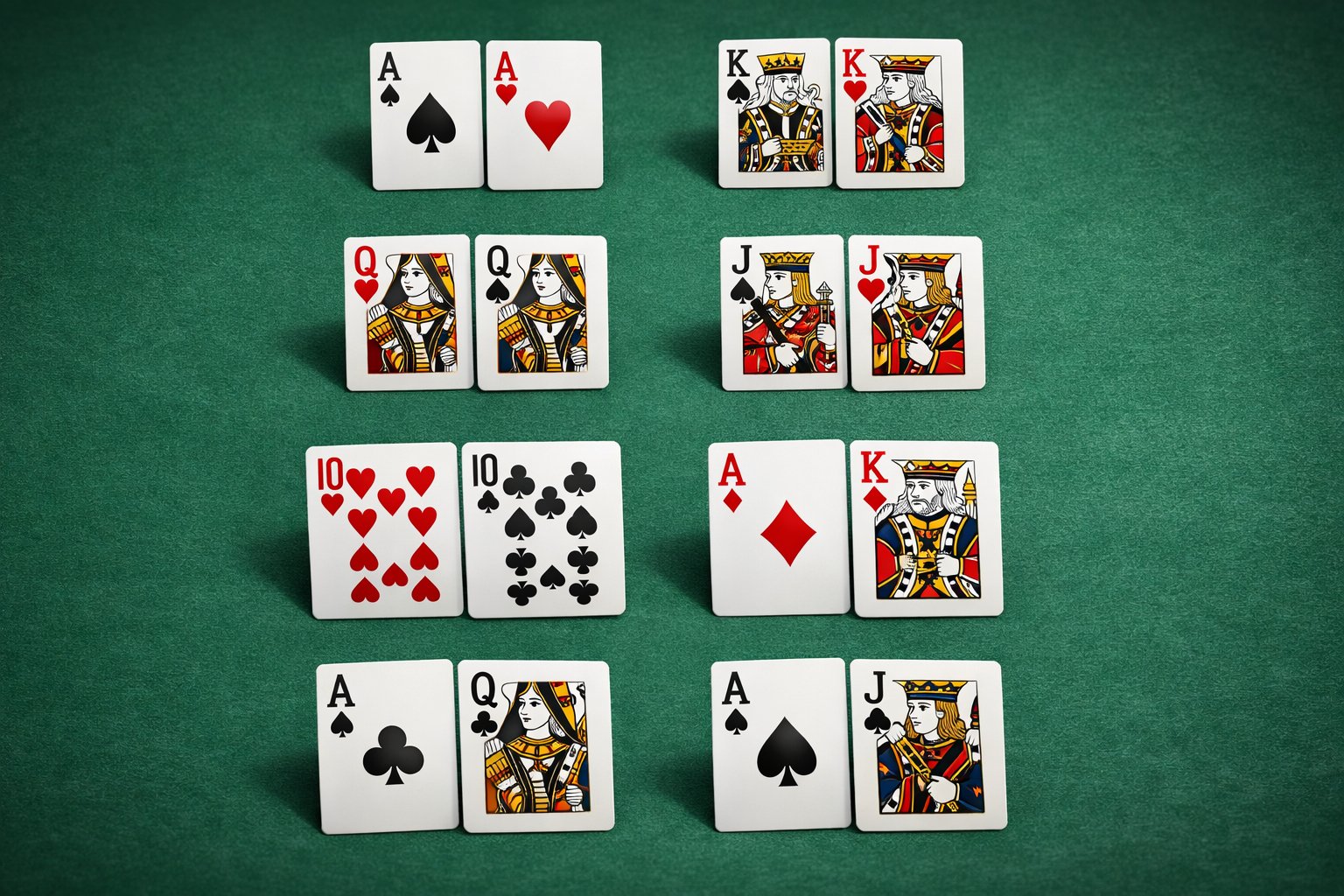
The strength of your starting hand determines your chances before any community cards appear. Pocket aces win about 31% of the time against nine random hands, while pocket kings win roughly 26%, and the percentages drop from there as you move down the rankings.
Premium Pocket Pairs
Pocket aces stand alone as the strongest starting hand in Texas Hold’em. You’ll win approximately 80% of the time against pocket kings and 87% against ace-king. Your goal with aces should be getting as many chips in the pot as possible before the flop.
Pocket kings rank second and dominate every hand except aces. They win about 26% against nine opponents. The main concern with kings is seeing an ace on the flop, which happens often enough that many players call them “ace magnets.”
Pocket queens give you the third-best starting hand, winning roughly 22% against nine random hands. You need to watch for both aces and kings on the board. Queens also struggle against AK, creating a coin-flip situation instead of the dominant position you want with premium pairs.
Pocket jacks present the trickiest premium pair to play correctly. JJ wins about 19% against nine opponents and sits closer to tens than queens in actual strength. Any overcard on the flop (which includes queens, kings, and aces) creates problems since opponents frequently play high cards.
Top Non-Pair Hands
Ace-king suited (AKs) ranks as the fourth-best starting hand overall, winning 20.2% against nine opponents. You have two ways to make the nut flush and the only straight you can hit is Broadway (ace through ten). When you flop top pair, you also have top kicker, protecting you from losing to weaker aces.
AK offsuit (AKo) drops to seventh in the rankings but remains a powerhouse hand. The lack of flush potential reduces your winning percentage slightly, but you still dominate most ace-high hands and flip against pocket pairs below aces.
Ace-queen suited (AQs) and ace-jack suited (AJs) round out the elite non-pair hands. These give you strong top-pair potential with solid kickers. The suited versions let you chase nut flushes when appropriate. You should play these hands aggressively from most positions but proceed carefully against heavy action that suggests opponents hold stronger aces or premium pairs.
Playable Hands Beyond the Top 10
Medium pocket pairs from tens down to sevens (TT, 99, 88, 77) perform well in the right situations. These hands win by flopping sets about 12% of the time or by holding up against unpaired hands. You can often raise with them from late position but should be cautious facing reraises.
Suited connectors like jack-ten suited and ten-nine suited offer strong playability after the flop. They can make straights, flushes, and two-pair combinations. These hands work best with deeper stacks where you can see flops cheaply and win big pots when you connect.
Broadway cards like king-queen and king-jack give you decent top-pair potential. The suited versions play better than their offsuit counterparts because of flush possibilities. You should be selective with these hands from early position but can open them more liberally from the cutoff and button seats.
Types of Starting Hands
Starting hands in Texas Hold’em fall into three main categories based on how the two cards relate to each other. Pocket pairs give you an instant made hand, suited hands offer flush potential along with other possibilities, and offsuit hands vary widely in strength depending on their ranks.
Pocket Pairs Breakdown
Pocket pairs are unique because you start with a made hand before the flop. Premium pocket pairs like aces, kings, and queens are the strongest starting hands you can receive. These hands are profitable from any position at the table.
Medium pocket pairs from tens down to sevens play well but need more caution. You should raise with these hands from most positions, but be prepared to fold if you face heavy action.
Small pocket pairs like sixes down to deuces are speculative hands. You’re mainly trying to hit three-of-a-kind on the flop. These hands work best when you can see the flop cheaply from late position. If you don’t improve on the flop, you’ll usually need to fold to aggression since a single pair of sixes or fours rarely wins at showdown in multi-way pots.
Suited Hands and Suited Connectors
Suited hands give you the chance to make a flush along with other strong combinations. Suited aces are particularly valuable because they can make the best possible flush. Even weaker suited aces like A4s or A5s become playable from late position.
Suited connectors like JTs, T9s, and 98s are powerful drawing hands. These cards can connect with the board to make straights, flushes, or two pair. JTs is strong enough to play from almost any position.
Suited one-gappers include hands like J9s, T8s, and 97s. These hands have slightly less straight potential than suited connectors but still offer decent playability. The higher suited one-gappers like KJs and QTs are strong enough for early position raises.
Lower suited connectors and gappers like 76s or 64s should only be played from late position when you’re getting the right pot odds.
Offsuit and Speculative Hands
Offsuit hands lack the flush potential of suited cards, which makes them significantly weaker in most cases. Premium offsuit hands like AK and AQ are still very strong and should be played aggressively from any position.
Broadway offsuit hands like KQ, AJ, and KJ are decent but require more selectivity. These hands play better from middle to late position where you have more information about other players’ actions.
Lower offsuit hands become speculative hands that you should usually fold. Hands like J8o, T7o, or K5o rarely connect well enough to justify playing. The only offsuit hands worth playing from late position are those with gap-filling potential like QJo or JTo, and even these need favorable conditions like unopened pots.
Position and Starting Hand Selection
Where you sit at the table changes which hands you should play. Players in early positions need tighter ranges because many players act after them, while late position players can profitably play more hands since they have more information and fewer opponents to act behind them.
Early Position Strategy
Early position includes under the gun, UTG+1, and UTG+2. These seats are first to act before the flop, which puts you at a disadvantage throughout the hand.
You should play only your strongest hands from early position. This means premium pocket pairs like TT+, strong suited Broadway hands like AKs, AQs, and AJs, and the best offsuit combinations like AKo and AQo. Some middle pocket pairs like 88 and 99 work well here too.
Fold hands like small pocket pairs (66 and below) and suited connectors from these positions in a full ring game. You’ll face raises and calls from players behind you, so your starting hand needs to hold up against multiple opponents.
The key is patience. Most hands you’re dealt should go straight into the muck from early position.
Middle Position Strategy
The LoJack and HiJack make up middle position. You can expand your range here because fewer players remain to act after you.
Add all pocket pairs 55+ to your opening range from middle position. Suited aces become playable (A2s+), along with suited connectors like 76s, 87s, and 98s. You can also start raising with suited one-gappers such as J9s, T8s, and 97s.
Include some suited two-gappers with Broadway cards like Q9s and K9s. Offsuit hands like AJo and KQo become profitable raises from these seats.
Your range is still selective but significantly wider than early position. You’re balancing the need for strong hands with the opportunity to win pots when later position players fold.
Late Position and Button Play
The button is the most profitable seat in poker. You act last on every street after the flop, giving you maximum information about your opponents’ actions.
Your button opening range should include almost all pocket pairs (22+), most suited kings (K4s+), suited queens down to Q6s, and many suited aces (A2s+). Play suited connectors as low as 43s and suited one-gappers starting from 53s.
Add offsuit hands like A4o+, K9o+, Q9o+, J9o+, and T9o. Even weaker suited hands like J7s, T7s, and 96s become profitable because you’ll often win the pot when both blinds fold.
The cutoff (one seat right of the button) uses a slightly tighter range than the button but still plays significantly more hands than earlier positions. Your positional advantage makes marginal hands profitable.
Playing from the Blinds
The small blind and big blind are the worst positions at the table. You act first on every postflop street, which is a major disadvantage.
From the big blind, you’ve already invested one big blind, so you can call raises with a wider range than you’d open from other positions. Hands like suited connectors and small pocket pairs have good pot odds to call a single raise.
The small blind requires a tighter defending range since you’re out of position and need to invest more money to see the flop. Focus on hands that play well postflop like pocket pairs, suited aces, and suited Broadway combinations.
When the action folds to your small blind, you should raise with a wide range to attack the big blind. However, this range is still tighter than a button opening range because you’ll be out of position if called.
Starting Hand Charts and Cheat Sheets
Starting hand charts provide a visual framework for deciding which hands to play based on your position at the table. Hand rankings and poker odds help you understand the strength of different starting hands, while adjustments between live and online games ensure your strategy fits the environment.
Using Starting Hand Charts Effectively
A starting hand chart shows you exactly which hands to play from each position at the table. You should reference these charts when you’re learning, especially during online sessions where you can keep one visible on your screen.
Position matters more than your cards in many situations. A hand like K-Q offsuit plays well from the button but should be folded from early position. Your starting hands chart adjusts for this by showing tighter ranges for early positions and wider ranges for late positions.
Most poker cheat sheets color-code hands to make quick decisions easier. Green typically means raise, yellow means call in certain situations, and red means fold. You can also use tools like Equilab to analyze hand ranges and compare them against your chart.
Don’t treat these charts as absolute rules. Table dynamics, stack sizes, and opponent types all influence whether you should play a hand. A standard chart gives you a baseline, but you need to adjust based on what’s happening at your specific table.
Hand Rankings and Charts Explained
Starting hands charts organize the 169 possible hand combinations into groups based on strength. Pocket pairs, suited connectors, and high cards all occupy different spots in the hand rankings.
The strongest hands (AA, KK, QQ) appear at the top of every chart. These premium pairs should be played aggressively from any position. The next tier includes hands like AK and AQ, which dominate weaker ace hands but can still run into trouble.
Medium pairs (99-JJ) and suited connectors (like 9♠8♠) need the right conditions to be profitable. Your chart will show these as playable from middle and late positions but not from under the gun. Small pairs and suited aces work best when you can see a cheap flop with multiple opponents.
Poker odds directly connect to hand strength. You’re dealt pocket aces only 0.45% of the time, while you’ll see suited connectors much more frequently. Understanding these probabilities helps you interpret what your chart is telling you about long-term profitability.
Making Adjustments for Live and Online Games
Online poker moves faster than live games, which means you’ll face more hands per hour and need quicker decisions. Your poker cheat sheet becomes more valuable online since you can reference it between hands without anyone noticing.
Live games tend to be looser, with players calling more often and playing weaker hands. You can adjust your starting hands chart by playing slightly tighter and targeting value from opponents who call with dominated hands. In online games, especially at higher stakes, you’ll face tighter ranges and need to respect raises more.
Stack depth changes how you use your chart in both formats. Deep-stacked live games let you play more speculative hands like small pairs and suited connectors because you can win bigger pots. Short-stacked online tournaments require you to focus on hands that work well all-in, like big pairs and strong aces.
Your physical tells matter in live games but are irrelevant online, where timing tells and bet sizing become more important. This doesn’t change your starting hands chart directly, but it affects how aggressively you play marginal hands from your range.
Strategic Considerations for Different Game Formats
The strength of your starting hands changes based on whether you’re playing cash games or tournaments, sitting at a live table or clicking buttons online. Stack depths, table speed, and blind pressure all affect which hands are worth playing and how aggressively you should play them.
Adjusting for Cash Games
Cash games let you play deeper stacks than most tournaments, which means implied odds become more important than immediate pot odds. Hands like small pocket pairs and suited connectors gain value because you can set mine profitably when stacks are 100 big blinds or deeper.
You should widen your starting hand range in cash games compared to early tournament play. The lack of increasing blinds means you can wait for good spots without worrying about your stack shrinking. This lets you play more speculative hands in position.
Pay attention to stack sizes at your table. When opponents have deep stacks, you can call with hands that have strong implied odds potential. If you hit a set with pocket fives and your opponent has top pair, you can win their entire stack. When stacks are shallow, stick to stronger starting hands that make strong pairs and avoid hands that rely on hitting big hands to be profitable.
Live Poker Versus Online Poker
Live poker plays slower than online poker, giving you 25 to 30 hands per hour compared to 60 to 80 hands online. This pace difference affects your poker strategy for starting hand selection. You need more patience in live games because you’ll see fewer hands.
Online poker lets you multi-table, which means you can play tighter ranges and still see plenty of action. Live players often play looser because they’re bored waiting for premium hands. You can exploit this by playing slightly tighter than average and targeting players who play too many weak hands.
Table dynamics are easier to read in live poker through physical tells and betting patterns. Online poker requires you to focus on bet sizing, timing tells, and hand histories. Your starting hand decisions should factor in these different information sources. Live games often feature more calling stations and fewer aggressive players, making hands like big pocket pairs more valuable since you’re more likely to get paid off.
Table Dynamics and Stealing the Blinds
Your starting hand requirements change dramatically based on table dynamics. At tight tables, you can steal the blinds with a wider range from late position because opponents fold too often. At loose tables, you need stronger hands to enter pots because you’ll face more resistance.
Position matters more when you’re trying to steal the blinds. From the button or cutoff, hands like K9s, Q10o, and A5s become profitable raising hands against tight blinds. These same hands should be folded from early position.
Watch for dominated hands when stealing becomes common. If multiple players are trying to steal the blinds, your Ace-rag hands lose value because you’ll often run into better Aces. Focus on pairs and suited broadways that play well against stealing ranges.
Blind stealing guidelines:
- Raise 2.5 to 3 times the big blind from late position with any pair, suited Aces, and Broadway cards
- Fold small Aces like A2o through A7o from early position, even at tight tables
- Three-bet from the blinds with premium hands when opponents steal too frequently
- Call from the big blind with suited connectors and small pairs when getting good pot odds
Frequently Asked Questions
Pocket aces stand as the strongest starting hand in Texas Hold’em, while hand rankings depend on factors like pairs, suited cards, and card strength. Position and table dynamics affect which hands you should play from the 169 possible starting combinations.
What is the best starting hand in Texas Hold’em poker?
Pocket aces (AA) is the best starting hand you can receive in Texas Hold’em. This hand gives you the highest win probability before any community cards appear on the board.
You start with a pair already made, which puts you ahead of all other possible starting hands. Pocket aces win roughly 85% of the time against any single random hand.
How are starting hands ranked in Texas Hold’em?
Starting hands get ranked based on their strength and winning potential. Premium pocket pairs like AA, KK, and QQ rank at the top because they’re already made pairs with high card values.
Suited broadway cards like AKs and AQs rank next because they can make strong pairs, straights, and flushes. Offsuit broadway hands like AKo and KQo follow since they can make top pairs but lack flush potential.
Lower pocket pairs, suited connectors, and suited gappers make up the middle tier. These hands need to improve on the flop to win but have decent potential when they hit.
Can you provide a chart or cheat sheet of Texas Hold’em starting hands?
A starting hands chart separates playable hands by position at the table. From early position, you should play premium pairs (AA-99), big offsuit broadway hands (AKo, AQo, KQo), and strong suited hands (AKs, AQs, KQs).
Middle position allows you to add mid-pocket pairs (88-77), more offsuit broadway cards (ATo+, KJo+), suited aces (A2s+), and suited connectors (QJs+, JTs+, T9s+). Late position lets you play the widest range, including small pocket pairs (22+), more suited connectors (32s+, 53s+), and additional offsuit cards.
The “s” notation means suited cards of the same suit. The “+” symbol indicates you should play that hand plus all stronger versions.
What percentages are associated with the odds of winning with different starting hands in Texas Hold’em?
Pocket aces win approximately 85% against one random hand and about 31% in a nine-player pot. Pocket kings win roughly 82% heads-up and drop to around 26% with nine players.
Suited broadway hands like AKs win about 67% heads-up against random hands. Mid-pocket pairs like 88 win around 69% in heads-up situations.
Small pocket pairs like 22 win approximately 50% against two random overcards. Suited connectors like 76s have winning percentages that range from 40-60% depending on the opponent’s holding.
How does the strength of starting hands compare in Texas Hold’em?
Premium pocket pairs (AA-JJ) dominate most other starting hands before the flop. These hands have built-in pair value and don’t need help from the board to be competitive.
Big suited broadway hands rank just below premium pairs because they can make top pairs, straights, and flushes. Their offsuit versions rank slightly lower since they lose the flush potential.
Mid-pocket pairs and suited connectors have similar strength but win in different ways. Pocket pairs hope to make sets while suited connectors aim for straights and flushes.
What is the statistical ranking of all the possible starting hands in Texas Hold’em?
Texas Hold’em has 169 unique starting hand combinations when you account for suits. Pocket aces rank first, followed by pocket kings, pocket queens, and ace-king suited.
You should typically play only the top 10-15% of all starting hands to maintain a profitable strategy. This equals roughly 17-25 hand combinations depending on your position and table conditions.
The weakest starting hands include offsuit low cards like 72o, 82o, and 32o. These hands have minimal winning potential and should almost never be played regardless of position.