
Rolling a perfect twenty can feel amazing, but have you ever wondered if your dice are actually giving you fair results? Dice balance refers to how evenly weighted a die is, which directly affects whether each number has an equal chance of appearing when you roll. Even small imperfections in materials or manufacturing can cause certain numbers to show up more often than others.

Most players never think about checking their dice for balance. They assume the dice they buy are fair and random. However, dice can be unbalanced for many reasons, from air bubbles in the resin to uneven weight distribution from painted numbers. Understanding what makes dice balanced helps you know when your luck is actually bad luck or when your dice might be working against you.
You don’t need expensive equipment or casino-level testing to check your dice. Simple at-home methods can reveal if your dice are balanced, and knowing what causes imbalance helps you choose better dice in the future. Whether you play casual board games or competitive tabletop RPGs, learning about dice balance gives you confidence that your rolls are truly random.
What Is Dice Balance?

Dice balance determines whether each side of a die has an equal chance of landing face up when you roll it. A balanced die gives you truly random results, while an unbalanced die favors certain numbers over others.
Definition of Balanced and Unbalanced Dice
A balanced die is one where every face has the same probability of appearing when rolled. For a standard six-sided die, each number should have a 1 in 6 chance of landing face up. This requires the die to have equal dimensions, uniform weight distribution, and symmetrical geometry.
Balanced dice have these key features:
- Identical shape and size on all faces
- Even weight throughout the die
- Symmetrical geometric design
- No manufacturing defects
Unbalanced dice suffer from imperfections that give certain numbers an advantage. These problems include uneven weight distribution, irregular shapes, or air bubbles in the material. Even small flaws can cause one side to land face up more often than it should.
The concept of “fair by symmetry” means a die is completely fair when each side has exactly the same dimensions and shape. More symmetries in a die’s design lead to more random rolls.
Why Dice Balance Matters in Gaming
Dice fairness directly affects your gaming experience and the integrity of gameplay. When you roll unbalanced dice, certain players may get better or worse results than others through no fault of their own.
For casual board game nights, small imperfections in mass-market dice won’t ruin your fun. The slight deviations from perfect balance rarely change the outcome of a campaign or game.
Competitive play demands higher standards. Tournament players and serious gamers need precision dice to maintain fair gameplay. Casinos take this even further by using strictly controlled dice with serial numbers, regular inspections, and replacement every 4-8 hours.
In tabletop roleplaying games like Dungeons & Dragons, balanced dice help preserve the randomness that makes gameplay exciting. You want your character’s fate determined by chance, not by a weighted die.
Probability and Fair Dice
Fair dice follow mathematical probability rules. A six-sided die should show each number roughly 16.7% of the time over many rolls. A twenty-sided die should display each face about 5% of the time.
When dice balance is off, these probabilities shift. An unbalanced die might show a “6” 25% of the time instead of 16.7%. This 8.3% difference means you’ll roll that number once every four rolls instead of once every six rolls.
The Greek mathematician Archimedes identified 30 varieties of fair dice roughly 2,000 years ago. A Stanford mathematician later proved this correct. Your standard gaming dice all fall within these categories.
Perfect balance remains technically impossible. Physics can’t account for every variable like air resistance, friction, gravity, and table surface. Quality dice manufacturers can achieve 99.999% randomness, but never true 100% perfection.
How Dice Are Made and Causes of Imbalance
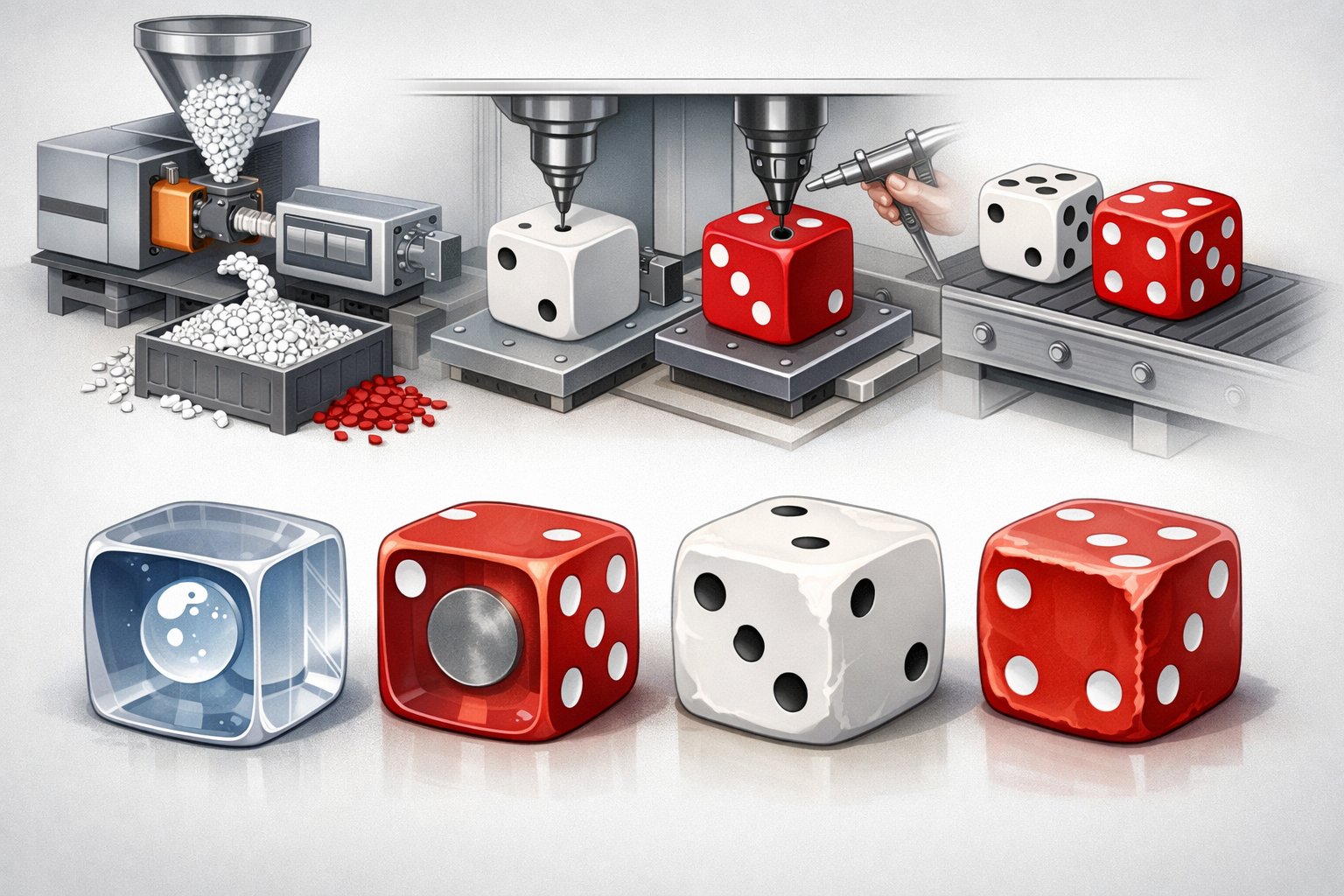
The manufacturing process directly affects whether your dice roll fairly. Materials like plastic, resin, and metal each create different challenges for achieving proper balance, while production flaws and finishing techniques can introduce biases that favor certain numbers.
Manufacturing Methods and Materials
Dice manufacturers use several methods to create dice, each with different impacts on balance. Injection molding is the most common method for mass-produced plastic dice. Molten plastic gets injected into steel molds under high pressure, creating consistent results in seconds per die. This method works well for standard gaming dice but can create small variations in density.
Resin casting has become popular for custom and artisanal dice. Liquid resin gets poured into silicone molds and cured under pressure to remove air bubbles. This method allows for unique color combinations and effects like those in translucent dice and liquid core dice. The pressure curing process typically uses 30-50 PSI to compress bubbles to microscopic sizes.
Metal dice require different manufacturing approaches. Aluminum, zinc, and brass dice are often created through die casting or CNC machining. Metal dice weigh significantly more than plastic versions—a standard metal d6 weighs 15-45 grams compared to 2-4 grams for plastic. Casino dice undergo the most rigorous manufacturing processes, using precision-engineered molds with tolerances within 0.05mm to ensure fair play.
Common Flaws: Air Bubbles, Inclusions, and Imperfect Molds
Air bubbles represent one of the most common balance problems in resin dice. When resin isn’t properly cured under pressure, bubbles remain trapped inside the die. These air pockets create areas of lower density that make certain faces lighter. Even small bubbles can affect rolling statistics over thousands of rolls.
Inclusions like glitter, embedded objects, or layered colors add visual appeal but can create weight imbalances. Liquid core dice face particular balance challenges because the liquid moves inside the die. The liquid-filled core changes the weight distribution depending on how the die settles, making consistent rolls harder to achieve.
Imperfect molds cause dimensional inconsistencies that affect balance. If mold cavities aren’t perfectly symmetrical, the resulting dice will have uneven faces and angles. Mass-produced dice sometimes show variations between batches when molds wear down. Precision dice and casino dice use high-quality steel molds maintained to strict specifications, but budget dice often come from worn or imprecise molds.
Material inconsistencies during production also create problems. If the plastic, resin, or metal used to make dice has varying density throughout, the finished die will have unbalanced weight distribution.
Influence of Numbering and Painting
The way numbers get added to dice affects their final balance. Laser engraving removes material from the die surface to create number recesses. This removal makes engraved faces slightly lighter than unmarked faces. The deeper the engraving, the more material gets removed, creating larger weight differences.
Paint-filling partially compensates for engraved material removal. After engraving, manufacturers apply paint to fill the number recesses. The paint adds weight back to engraved faces, but rarely equals the exact weight of removed material. Different paint types and application thicknesses create variations between dice.
Printed numbers sit on top of the die surface rather than being engraved into it. This method adds weight to numbered faces instead of removing it. The ink layer is thin but still affects balance, especially on lighter plastic dice. Casino dice use specially formulated inks applied in precise amounts to minimize balance effects.
Handcrafted dice face additional challenges with numbering consistency. Even skilled artisans struggle to apply identical paint amounts to each face. Small variations in paint thickness across a die’s faces create subtle biases that accumulate over many rolls.
Dice Types and Their Balance Considerations
Different dice shapes and materials face unique balance challenges. A d20 has more faces to distribute weight across than a d6, while metal and liquid core dice introduce density problems that plastic dice don’t have.
D20 Dice Balance Issues
The twenty-sided die is particularly vulnerable to balance problems because of its complex geometry. Each face is a small triangle, and even tiny manufacturing defects can affect how the die lands. Air bubbles near one face pull the center of gravity off-center more noticeably than they would in a simpler shape.
Paint in the numbers creates imbalance too. A d20 has twenty numbers to fill, and some numbers (like 10, 18, or 20) use more paint than others (like 1 or 7). This adds up to uneven weight distribution across the die.
The sharp points on a d20 wear down faster than the faces of a cube. When you roll your d20 repeatedly, certain edges can round off, making those faces more likely to appear. Casino-style precision d20s use harder materials and skip the paint entirely to avoid these issues.
D6 and Other Polyhedral Dice
Six-sided dice are easier to balance because of their simple cubic shape. The weight distributes evenly across six equal squares. Standard d6s use pips (dots) instead of numbers, and manufacturers often drill opposite sides to equal depths so the 1 and 6 balance each other out, the 2 and 5 balance, and the 3 and 4 balance.
Other polyhedral dice (d4, d8, d10, d12) fall between the d6 and d20 in terms of balance difficulty. The d4 is a pyramid with only four faces, making it fairly stable. The d8 (octahedron) and d12 (dodecahedron) have more faces but maintain regular geometry.
The d10 stands out as potentially problematic. It’s technically a pentagonal trapezohedron, not a regular polyhedron. This irregular shape makes precision manufacturing harder and balance testing more important.
Liquid Core, Metal, and Translucent Dice
Metal dice add significant weight to your rolls, but they also add balance concerns. Heavier materials magnify any imperfections in the mold or air pockets in the casting. A bubble that barely matters in a plastic die becomes a real problem in zinc alloy or brass.
Liquid core dice contain suspended glitter, small objects, or colored fluid inside a clear shell. The liquid shifts as you roll, changing the die’s center of gravity mid-tumble. This makes them inherently less balanced than solid dice, though the effect is usually minor for typical gameplay.
Translucent dice let you see inside them, which helps you spot air bubbles or other defects before you buy. Clear or semi-transparent materials don’t hide manufacturing flaws the way opaque dice do. You can hold them up to light and check for irregularities that might affect balance.
Testing Dice Balance: At-Home Methods
You can check if your dice are balanced using simple tests at home that require only basic materials. The saltwater test remains the most popular method for detecting major imbalances, while visual inspections help identify physical defects that affect fairness.
Saltwater Test Procedure
Fill a glass with water and add salt gradually until your die floats. You need enough salt to make the water dense enough to support the die’s weight. Stir until the salt dissolves completely.
Place the die gently into the saltwater and give it a light spin. Watch which number faces upward when it stops moving. Repeat this process 10-15 times, recording which numbers appear on top.
A balanced die will show different numbers facing up in a random pattern. If the same number or numbers consistently face upward, your die likely has an internal imbalance. The weight distribution inside the die is uneven, causing it to favor certain faces.
This saltwater float test works best for standard plastic dice. It may not give accurate results for metal dice or very dense materials because they require extremely high salt concentrations to float.
Saltwater Float and Balancing Test Variations
You can adjust the salt concentration to create different testing conditions. Some players use supersaturated saltwater solutions for heavier dice, adding salt until no more dissolves.
Try the spin method: float the die and spin it vigorously, then observe which face settles on top. Do this 20 times for better accuracy. Another variation involves the tap method, where you gently tap the glass between observations to see if the die rotates or stays fixed.
Temperature affects the test results. Room temperature water works best because cold water makes salt dissolve more slowly. Warm water can make dice float differently due to density changes.
Some testers mark a small dot on one face with a marker to track rotation patterns more easily. This helps you see if the die rotates freely or returns to the same position repeatedly.
Visual and Physical Inspections
Examine your dice under bright light to spot physical defects. Look for air bubbles trapped inside clear dice, which create weight imbalances. Check for uneven surfaces, chips, or rough edges that affect how the die rolls.
Roll the die across a flat, hard surface and watch its movement. A balanced die should tumble randomly and come to rest in different positions. If it wobbles, stops too quickly, or favors certain edges, the shape may be imperfect.
Compare the weight of dice from the same set by holding one in each hand. Noticeable weight differences indicate manufacturing inconsistencies. You can also measure opposite sides with calipers to verify the die is truly cubic.
Inspect the number pips or engravings. Deep engravings remove more material from certain faces, potentially creating slight imbalances. This matters more in precision gaming than casual play.
Statistical Approaches to Evaluating Dice Fairness
Testing dice fairness requires collecting data through repeated rolls and applying statistical methods to determine if results match expected probabilities. A fair die should show each face with equal frequency over many rolls, and statistical tests help you identify meaningful deviations from this pattern.
Roll Test and Recording Results
You need to roll your dice many times to gather enough data for analysis. Most experts recommend at least 300 to 600 rolls for a six-sided die, though 1,000 rolls provides more reliable results.
Record each outcome in a table or spreadsheet. Create a simple frequency table that shows how many times each face appears. For a six-sided die rolled 600 times, you would expect each number to appear approximately 100 times if the die is fair.
Basic Recording Table:
| Face | Observed Count | Expected Count |
|---|---|---|
| 1 | 95 | 100 |
| 2 | 103 | 100 |
| 3 | 98 | 100 |
| 4 | 107 | 100 |
| 5 | 101 | 100 |
| 6 | 96 | 100 |
The rolling surface matters for accurate testing. Use a flat, hard surface and roll the die with consistent force to avoid introducing bias into your test results.
Applying the Chi-Square Test and Other Methods
The chi-square test is the most common statistical method for evaluating dice fairness. This test compares your observed frequencies against expected frequencies to determine if differences are due to chance or actual bias.
Calculate the chi-square statistic using this formula: add up (observed – expected)² divided by expected for each face. Using the example above: (95-100)²/100 + (103-100)²/100 + (98-100)²/100 + (107-100)²/100 + (101-100)²/100 + (96-100)²/100 = 1.48.
Compare your result to a critical value from a chi-square table. For a six-sided die at a 95% confidence level, the critical value is 11.07. If your calculated value is less than 11.07, the die is likely fair.
Alternative Methods:
- Bayesian analysis updates probability estimates as you collect more data
- Running chi-square test tracks the statistic over time to detect developing biases
- Visual probability plots help identify patterns in your data
Sample Size and Statistical Significance
Your sample size directly affects the reliability of your test results. Too few rolls may miss subtle biases, while too many rolls can flag minor manufacturing variations that don’t affect gameplay.
For standard six-sided dice, 300 rolls provides a minimum acceptable sample. Precision dice used in competitive gaming should be tested with 600 to 1,000 rolls. Specialty dice with more faces require larger samples—a 20-sided die needs at least 500 rolls for meaningful results.
Statistical significance is typically set at the 95% confidence level (p-value of 0.05). This means you accept a 5% chance that random variation, not actual bias, caused your results. A p-value below 0.05 suggests the die is biased.
Sample Size Guidelines:
| Die Type | Minimum Rolls | Recommended Rolls |
|---|---|---|
| d6 | 300 | 600-1,000 |
| d20 | 500 | 1,000-1,500 |
Larger samples reduce the margin of error and increase your confidence in the test outcome. Fair dice and precision dice should both pass these statistical tests when properly manufactured.
Best Practices for Fair Gameplay and Maintaining Dice Balance
Proper rolling techniques and storage protect your dice from developing imbalances over time. Regular assessment of your dice condition helps you catch problems before they affect your games.
Using a Dice Tray and Proper Rolling Techniques
A dice tray provides a consistent rolling surface that protects both your dice and your gaming table. The contained space prevents dice from falling on hard floors where impacts can chip edges or create internal cracks.
Rolling your dice with a gentle toss gives them enough tumbling action without causing damage. Avoid throwing dice hard against surfaces or shaking them aggressively in your hand before rolling. These rough handling methods can gradually knock dice out of balance.
Key rolling practices:
- Roll from a low height of 6-8 inches
- Let dice tumble naturally without forcing them
- Avoid rolling on hard surfaces like wood or tile
- Use felt-lined or padded dice trays when possible
The rolling surface matters as much as your technique. Soft materials like felt, leather, or neoprene absorb impact and reduce wear on your dice over time.
When to Replace or Retire Dice
Visible damage signals it’s time to retire a die from competitive play. Chips, cracks, or worn edges change how a die rolls and can create bias toward certain numbers.
Check your dice regularly for these signs:
- Chips or cracks in the material
- Rounded or flattened edges
- Faded or unreadable numbers
- Clouding or discoloration inside clear dice
For casual tabletop gaming, slightly worn dice may still work fine. For competitive play or games where balance matters most, replace damaged dice immediately. You can keep retired dice as backup sets for practice or low-stakes games.
Test your dice every few months using a saltwater float test or by tracking roll results over 100+ rolls. If a die consistently favors certain numbers, retire it from your active collection.
Choosing Reliable Dice for Tabletop Gaming
Quality manufacturing makes the biggest difference in dice balance. Look for dice made with precision molds and injection molding techniques rather than hand-poured methods that can trap air bubbles.
What to look for when buying gaming dice:
- Sharp, crisp edges rather than rounded corners
- Uniform coloring without swirls or clouding
- Painted numbers rather than stick-on decals
- Clear statements about manufacturing standards
Metal and gemstone dice require extra care but can maintain balance well with proper handling. Resin and plastic dice work well for most tabletop gaming needs and resist damage better than softer materials.
Buy from manufacturers who test their dice for balance and publish their quality control methods. Mass-market dice from discount retailers often skip these testing steps, leading to inconsistent performance across sets.
Frequently Asked Questions
Testing methods range from simple float tests to statistical analysis of hundreds of rolls. Manufacturing quality and material choice play major roles in balance, while proper storage and handling help maintain fairness over time.
How can you test if your dice are balanced?
You can start with a visual inspection to check for obvious defects. Look at the shape, edges, and surfaces of your dice for any dents, scratches, or uneven spots. Hold each die in your hand to feel if the weight seems even on all sides.
The float test offers a simple way to check balance at home. Fill a clear container with water and add salt until your die floats. A balanced die will not consistently show the same face pointing up when you spin it in the water.
You can perform a rolling test by rolling each die at least 100 times on a flat surface. Record every result in a notebook or spreadsheet. Each face should appear roughly the same number of times if the die is balanced.
A chi-square statistical test gives you a scientific way to analyze your rolling data. This test compares your actual results to what you would expect from a perfectly balanced die. You can use online calculators or statistical software to run this test.
What are the implications of using unbalanced dice in tabletop games?
Unbalanced dice can favor certain outcomes over others during gameplay. This means some numbers will come up more often than they should. Your character might succeed or fail more frequently than the game designers intended.
Small imperfections in mass-market dice rarely create noticeable problems during casual play. Most gaming sessions will not see enough rolls for minor imbalances to significantly change the story. The random nature of dice rolling helps mask small manufacturing flaws.
Competitive play requires stricter standards for dice balance. When prizes or rankings are at stake, even small advantages matter. Players in tournaments often prefer precision dice that undergo extra quality testing.
Unbalanced dice can affect game mechanics over time. Combat encounters might become easier or harder than intended. Skill checks could skew toward success or failure, changing the feel of your campaign.
What methods are available to ensure dice balance during manufacturing?
Quality control during production is the most important factor in creating balanced dice. Manufacturers use precise molds and carefully measure materials to ensure even weight distribution. Each face must have the same size and shape for the die to roll fairly.
Precision dice undergo stricter testing during manufacturing. These dice are made with tighter tolerances and more careful attention to symmetry. Manufacturers may use specialized equipment to verify that each die meets specific balance standards.
Material selection affects how balanced a die can be. Resin, metal, and glass can all produce fair dice when manufactured correctly. The material itself matters less than the precision of the production process.
Some manufacturers offer calibration services for their premium dice. These companies test each die individually before selling it. You pay more for this extra quality assurance, but you get dice with verified balance.
Are there tools or accessories to help maintain dice balance?
Proper storage protects your dice from damage that could affect balance. Dice bags with soft interiors prevent scratches and chips. Hard cases with foam inserts offer even better protection by keeping each die separate.
You should avoid dropping dice on hard surfaces like concrete or tile. These impacts can chip edges or create small cracks. Roll your dice on dice trays or padded surfaces to reduce wear.
Clean your dice regularly with a soft, damp cloth. Dirt and oils from your hands can build up in number engravings. This buildup is minor but can theoretically affect how dice roll over many uses.
Micrometers and calipers let you measure each face of your dice. You can verify that all sides have the same dimensions. These tools are most useful for checking high-value or precision dice.
What constitutes a balanced dice set for role-playing games?
A balanced dice set has even weight distribution across all faces. Each number should have an equal chance of appearing when you roll. The die should have symmetrical geometry with uniform faces and edges.
Your dice should be free from visible defects. Check for bubbles in resin dice, as these create uneven weight. Look for consistent number engraving depth, since deep numbers on one side can shift the center of mass.
Standard polyhedral sets include seven dice with different numbers of faces. Each die in the set should meet the same quality standards. A balanced d20 matters most for many game systems since it determines success or failure on important checks.
Weight alone does not determine balance. Metal dice feel heavier than resin dice, but both materials can produce fair results. The evenness of mass distribution matters more than total weight.
How does dice balance affect gameplay and fairness in board games?
Fair dice ensure that game outcomes depend on strategy and luck in the intended proportions. When your dice roll true, you experience the game as the designers planned it. Unbalanced dice skew probabilities and can make games feel unfair or frustrating.
The impact of dice balance depends on how many rolls your game requires. Games with hundreds of dice rolls will show imbalances more clearly than games with just a few rolls. A slightly biased die might never affect a short game session.
Players build strategies around expected probabilities. If you know a six-sided die should roll each number about one-sixth of the time, you make decisions based on that math. Unbalanced dice break these calculations and can make optimal strategies perform poorly.
Trust between players depends partly on fair dice. When everyone uses balanced dice, no one gains an unfair advantage. This creates a level playing field where skill and luck determine outcomes rather than equipment quality.